

Safe lane changes are a critical skill for passing Canadian driving tests, such as Ontario's G2/G or British Columbia's ICBC tests. Examiners watch closely for proper signalling, mirror use, blind spot checks, and smooth execution. Mistakes like failing to signal, drifting, or cutting off other drivers can lead to penalties or immediate test failure. To ensure success, follow these steps:
- Check Mirrors and Blind Spots: Always scan your mirrors and perform a shoulder check to spot hidden vehicles or cyclists.
- Signal Early: Use your signal at least three flashes before steering to alert other drivers.
- Judge Safe Gaps: Use the "headlight rule" and aim for a 4-second gap in traffic.
- Steer Smoothly: Keep both hands on the wheel and maintain a steady speed while merging.
- Cancel Your Signal: Turn off your signal promptly after completing the lane change.
- Avoid Common Mistakes: Don’t change lanes at intersections or cut off other vehicles.
- Practise Test Routes: Familiarize yourself with actual test routes for better preparation.
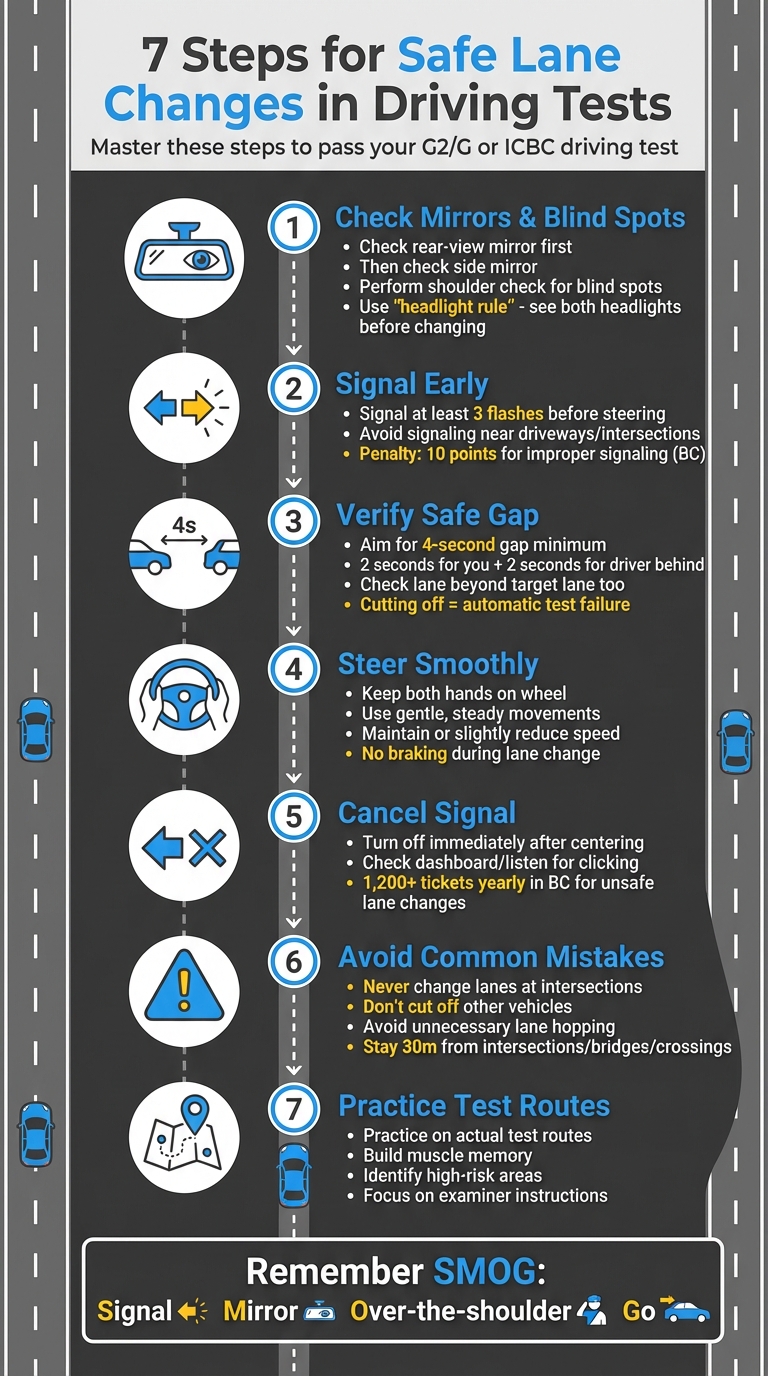
7-Step Process for Safe Lane Changes in Canadian Driving Tests
Step 1: Check Your Mirrors and Blind Spots
Before you signal or steer, take a moment to check your mirrors and scan your blind spots. Mirrors alone won't catch everything - there are always hidden areas where motorcycles, cyclists, or smaller vehicles can vanish from view.
Here’s the sequence to follow: Start with your rear-view mirror to see the traffic behind you. Then, check your side mirror to find an opening. Finally, do a shoulder check to ensure your blind spot is clear. To make this process seamless, it’s important to set up your mirrors properly.
How to Check Your Mirrors Correctly
Position your mirrors outward so you can just barely see the edge of your vehicle. This reduces blind spots and helps vehicles move smoothly from your mirror’s view into your peripheral vision.
When using your mirrors, keep your glances brief - just one or two seconds. Staring too long can distract you and even cause your car to drift. A good rule of thumb is the headlight rule: before changing lanes, you should see both headlights of the vehicle behind you in your centre rear-view mirror.
"Can't see both headlights of the vehicle behind you in the next lane in your centre rear-view mirror? Don't jam your vehicle into the space, leave your signal light on and monitor the gap." – DriveSmartBC
Why Shoulder Checks Are Required
Even with properly adjusted mirrors, blind spots will always exist. A shoulder check is the only way to confirm those areas are clear. This step is especially important for spotting cyclists and motorcyclists, who are often missed by mirrors. During driving tests, examiners will closely observe whether you turn your head every time.
"Mirrors do not show everything. Shoulder checks detect vehicles, cyclists, or motorcycles hidden in blind spots and are essential to preventing an improper lane change." – Canadian Smart Drivers
When performing a shoulder check, keep your hands steady on the wheel to avoid drifting in the direction you're looking. Also, be aware of traffic beyond your immediate target lane - a driver two lanes over might be trying to move into the same spot at the same time. In British Columbia, unsafe lane changes can result in tickets or an automatic test failure.
Step 2: Signal Your Intent Early
Once you've confirmed a clear view and a safe gap, the next step is to let other drivers know what you're about to do. Signalling is your main way to communicate on the road, and timing is everything. Drivers around you need enough notice to adjust, which is why examiners pay close attention during driving tests. Signal too late, and you risk surprising others. Signal too early, and you might cause confusion.
When and How to Use Your Signal
Activate your signal at least three flashes before you start steering. This gives drivers behind and beside you enough time to see your plan and adjust their speed or position. In busy traffic, it’s smart to signal even earlier to encourage others to make space for you.
Be cautious about where you signal. For example, avoid signalling near intersections with driveways or side streets, as other drivers might think you’re turning into one of those instead of continuing straight.
"That signal, made before you begin to change, must be made for long enough that the drivers around you realize your intent." – DriveSmartBC
How to Avoid Signal Errors
A common mistake is signalling after you’ve already started changing lanes. This defeats the purpose of giving other drivers a heads-up and can cost you points during your test. In British Columbia, failing to signal properly during an ICBC Driving Test can result in 10 penalty points.
Also, don’t forget to cancel your signal as soon as you’ve centred yourself in the new lane. Leaving it on too long can confuse others and lead to unnecessary hesitation. Make it a habit to turn off your signal once you’re securely in position.
Step 3: Verify Clear Space and Safe Distance
After signalling, your next step is to carefully evaluate whether there’s enough room for a safe lane change. This isn’t just about a quick glance - examiners are looking for precise judgement to ensure you’re not forcing other drivers to brake or swerve.
How to Judge Safe Gaps in Traffic
A simple way to measure the gap is by using the headlight rule. Before steering into the new lane, check your centre rearview mirror. If you can clearly see both headlights of the vehicle in the target lane, the gap is likely sufficient. If not, the space is too tight.
Aim for a total gap of at least 4 seconds - 2 seconds for your car and 2 seconds for the driver behind you. This buffer provides enough reaction time for everyone involved if something unexpected happens. On highways or in heavy traffic, this becomes even more important since higher speeds leave less room for error.
"The gap in traffic that you want to move into must be large enough. Ideally, you need at least a 4 second gap, two seconds following distance for you and two seconds following distance for the driver behind you." – DriveSmartBC
Don’t forget to check the lane beyond your target lane too. Another driver might also be trying to merge into the same spot, which could lead to a dangerous situation. During an ICBC driving test, cutting off another vehicle is considered a "Dangerous Action" and will result in an automatic failure.
Once you’ve confirmed the gap, adjust your position to maintain a safe distance from other vehicles.
How to Maintain a Safe Following Distance
While preparing for the lane change, keep a 2–3 second following distance from the car in front of you. To check this, pick a fixed point on the road, like a sign or a tree. When the car ahead passes that point, start counting: "one-thousand-one, one-thousand-two." If you reach the marker before finishing your count, you’re too close.
Maintaining this distance isn’t just for the test - it’s a key habit for avoiding rear-end collisions. In poor weather or on slippery roads, increase your following distance to at least four seconds. Examiners will be closely watching to see if you consistently keep safe distances throughout the manoeuvre.
Step 4: Steer Gradually Into the New Lane
Once you’ve confirmed there’s a safe gap, it’s time to steer into the new lane. The key here is smooth, controlled steering that keeps your vehicle stable - something examiners pay close attention to.
Now, let’s dive into how to position your vehicle accurately for a safe lane change.
How to Execute a Smooth Lane Change
Keep both hands firmly on the wheel throughout the manoeuvre to maintain full control. Use gentle, steady steering movements to guide your vehicle into the new lane. Avoid sudden or jerky motions, as these can cause your car to swerve or lose traction - especially in challenging weather or road conditions.
"The lane change itself needs to be deliberate, but smooth and steady." – Official Ministry of Transportation (MTO) Truck Handbook
Maintain your current speed or ease off the accelerator slightly to blend seamlessly with the flow of traffic in the target lane. Avoid braking during the manoeuvre, as this could catch the driver behind you off guard and increase the risk of a collision. Once your vehicle is primarily in the new lane, focus your gaze further down the road. This helps your steering naturally adjust to your new position and keeps your driving smooth.
How to Choose the Best Lane Position
Centre your vehicle within the lane, using the markings as a guide. Aim to position your car in a way that maximizes space from other vehicles. This buffer gives you extra time to react if someone else makes an unexpected move.
"Position your vehicle in the tire track that offers maximum space from surrounding traffic." – Canadian Smart Drivers
Be careful not to drift toward the edge of the lane. During an ICBC driving test, crossing a solid line or failing to signal properly could cost you 10 penalty points. Steady and deliberate steering is essential - hesitation can disrupt traffic flow and might even close the gap you were planning to use.
sbb-itb-43e39f6
Step 5: Cancel Your Signal After Completing the Change
Once you've successfully changed lanes, the next step is to cancel your signal right away to avoid confusing other drivers.
As soon as you're centred in your new lane, turn off your signal immediately. Leaving it on can send mixed messages to other drivers about your intentions.
Why Turning Off Your Signal Matters
If your signal stays on after the lane change, it can mislead others into thinking you're planning another manoeuvre. This can result in unnecessary braking, hesitation, or even unsafe driving decisions by those around you.
"The signal... must be cancelled when the lane change is complete" – Official Ministry of Transportation (MTO) Truck Handbook
Make sure to double-check that your signal is off by glancing at your dashboard or listening for the signal's clicking sound. If it's still active, switch it off right away.
In British Columbia, around 1,200 tickets are issued each year for unsafe lane changes, with improper signalling - such as failing to cancel - being a frequent factor. During an ICBC driving test, forgetting to cancel your signal can cost you 10 penalty points. After cancelling, take a moment to check your rearview mirror to ensure you've merged safely.
"Cancel signal. Check the condition of your new gates. Adjust your speed." – SGI Driver's Handbook
Step 6: Avoid Common Lane-Change Mistakes During the Test
Making mistakes during lane changes can seriously impact your driving test results. Examiners pay close attention to how you handle these situations, as errors often reflect poor judgement or unsafe driving practices.
Don't Change Lanes at Intersections
Changing lanes in or near an intersection is a big no-no. It’s one of the quickest ways to fail your test, as sudden movements in such areas increase the risk of collisions.
"Never change lanes at intersections." – Manitoba Driver's Handbook
If you find yourself in the wrong lane as you approach an intersection, stick to your current lane and go straight through. Do not attempt to switch lanes within the intersection. Instead, proceed safely and find a legal spot to turn around later. Many areas have rules against changing lanes within 30 metres of intersections, bridges, or railway crossings. Once you’ve entered an intersection, stay committed to your lane.
Another key point: avoid creating situations where other drivers have to react abruptly to your decisions.
Don't Cut Off Other Vehicles
Cutting into a gap that’s too tight or forcing another driver to brake is considered unsafe and will likely result in immediate failure during an ICBC driving test. Always ensure there’s enough space before making a lane change. A good rule of thumb is to maintain a 4-second following distance.
"Never make sudden lane changes by cutting in front of another vehicle, including bicycles. Other drivers expect you to stay in the lane you are already in." – Ontario Ministry of Transportation
Check for a safe gap and match the flow of traffic to merge smoothly. The goal is to make your lane change without disrupting others or causing them to adjust their speed.
Avoid Unnecessary Lane Changes
Lane changes should always have a clear reason. Switching lanes excessively or "lane-hopping" to save time can confuse other drivers and increase the risk of accidents, especially in heavy traffic or bad weather.
"Lane changing should always have a clear purpose. Uncertain drivers have difficulty or cause problems for the organization of traffic." – Canadian Smart Drivers
During your test, stay in your lane unless you need to turn, exit, or pass a slower vehicle. In challenging conditions like snow, ice, or rain, limit lane changes to situations where they’re absolutely necessary. Examiners value drivers who show patience and sound judgement over those who make frequent, unnecessary movements.
Here’s a quick reference guide to common mistakes and safer alternatives:
| Scenario | Action to Avoid | Safety Tip |
|---|---|---|
| Heavy Traffic | Weaving | Stay in your lane unless turning or exiting |
| Approaching Intersection | Changing lanes within the junction | Complete lane changes well before the intersection |
| Merging/Passing | Cutting off other vehicles | Use the "headlight rule" to confirm a safe gap |
| Poor Weather | Frequent lane changes | Change lanes only if essential; increase following distance |
Step 7: Practise With Actual Test Routes
Honing your lane-changing skills starts with practising in low-traffic areas to get comfortable with the basics. But to truly prepare for your driving test, you need to take it up a notch by practising on the actual test routes used by examiners. These routes help you build the muscle memory and quick decision-making skills needed for confident, safe driving. Gradually transitioning to these real-world scenarios is key to mastering the art of lane changes.
How Test Routes Can Sharpen Your Skills
Using dedicated resources tailored to test routes can make a big difference. When you know the exact route ahead of time, you eliminate the stress of navigating unfamiliar roads. This allows you to focus entirely on driving safely and following instructions. A great resource is Drive Test Routes, which offers downloadable GPS-based routes for various Drive Test Centres across Canada. For $14.99 CAD, you’ll receive a GPS-compatible test route for Google Maps, examiner mark sheets, and guides that highlight key areas for lane changes.
Practising on these specific routes helps you spot high-risk areas to avoid, like intersections with solid pavement markings or short merging lanes on highways. You’ll also get a sense of where examiners typically expect lane changes, such as when transitioning from residential streets to busier commercial areas or preparing for a left turn at a multi-lane intersection.
Why Real Test Scenarios Are Effective
Practising on actual test routes doesn’t just improve your technical skills - it builds your confidence. Repetition makes lane changes feel natural, and familiarity with the route helps you stay focused on the examiner’s verbal instructions. As the Ontario Ministry of Transportation explains:
"Directions will be given to you so that you will have plenty of time to do what the examiner has asked."
Conclusion: Master Safe Lane Changes for Driving Test Success
Key Takeaways
Executing safe lane changes boils down to sticking to a consistent process. The SMOG method - Signal, Mirror, Over-the-shoulder, and Go - serves as your go-to guide. As Carmel C. Tse, Director of Curriculum and eLearning at iPass Driving School, explains:
"The buzz word to remember in lane change is 'SMOG' - Signal, Mirror, Over-the-shoulder and Go."
Stick to the headlight rule and aim for a four-second gap between vehicles. Avoid changing lanes at intersections, over solid lines, or near pedestrian crossings. Unsafe lane changes can lead to hefty penalties, and during a driving test, actions like cutting off another driver result in immediate failure.
Speed management is just as important as positioning. Maintain your current speed or slightly increase it to match the flow of traffic in the new lane - never hit the brakes mid-manoeuvre. After completing the lane change, cancel your signal promptly to avoid confusing other drivers.
With these core principles in place, you’ll be well-prepared to tackle your driving test with confidence.
Final Tips for Passing Your Driving Test
Turn these principles into focused preparation and confident execution. Start practising in low-traffic areas to build your foundational skills, then gradually move to busier roads and actual test routes as you gain confidence. Repetition is key - over time, the steps will become second nature.
Practising on real test routes can give you a big advantage. Familiarity with road layouts, traffic flow, and common lane-change scenarios allows you to concentrate on executing each step smoothly. Tools like Drive Test Routes offer GPS-based routes for $14.99 CAD, complete with examiner mark sheets and guides highlighting areas where lane changes are commonly tested. This preparation helps you anticipate when and where to signal, check blind spots, and transition lanes - all while staying composed during the test.
FAQs
Why is it important to do a shoulder check even if your mirrors are properly adjusted?
A shoulder check is crucial because even well-adjusted mirrors can't show every angle around your vehicle. Blind spots - those areas your mirrors miss - can conceal vehicles, cyclists, or pedestrians. A quick glance over your shoulder ensures that nothing is lurking in these hidden zones before you change lanes.
This small action significantly increases safety, reducing the risk of collisions, particularly in heavy traffic or during a driving test. Being attentive and aware of your surroundings is a fundamental part of driving responsibly.
How can I judge a safe gap in traffic for a lane change?
To ensure a safe lane change, start by looking ahead on the road, roughly 12 seconds into the distance, to spot any potential hazards. Next, check your mirrors and perform a quick shoulder check to confirm there's enough room in the target lane for your vehicle to merge smoothly without causing disruptions.
A simple guideline is to make sure the gap is big enough to accommodate your vehicle while keeping a safe following distance from other cars. Use your turn signal at least 3–5 seconds before changing lanes to alert other drivers and give them time to adjust. Also, try to match the speed of the traffic in the lane you're moving into - this helps make the transition smoother and reduces the risk of sudden braking.
By combining these steps - scanning ahead, signalling early, and adjusting your speed - you can make lane changes safer and more confident, whether you're taking a driving test or navigating daily traffic.
What are the most common mistakes to avoid when changing lanes during a driving test?
Avoiding mistakes during lane changes is a big deal when you're preparing for your driving test. Here are some common errors to steer clear of:
- Skipping the blind spot check: Always do a shoulder check to make sure no vehicles or cyclists are hiding in your blind spot before switching lanes.
- Forgetting to signal: Use your turn signal early to let other drivers know what you’re planning to do.
- Sudden or jerky movements: Lane changes should feel smooth and controlled, not like a last-second swerve.
- Underestimating space: Make sure there’s enough room in the lane you’re moving into before merging.
Practising these habits on roads you know well can help you gain confidence. If you can, try using GPS-based driving test route guides to practise on real test routes - this can give you an edge when test day comes.