

Feeling anxious before a driving test can lead to mistakes, while confidence helps you stay calm, focused, and in control. Anxiety often causes racing thoughts, shaky hands, and hesitation, which can impact decision-making and driving performance. Confidence, on the other hand, allows you to think clearly, make steady decisions, and handle the test like a routine drive.
Here’s how you can shift from anxiety to confidence:
- Practice regularly on test routes to build familiarity.
- Use positive self-talk to replace negative thoughts.
- Try breathing exercises and visualization techniques to stay calm.
- Gradually increase challenges in practice sessions to build skills step by step.
Anxiety clouds judgement and disrupts driving, while confidence improves focus and execution. Preparation, mental strategies, and consistent practice are key to managing nerves and passing your test with ease.
Common Signs of Driving Test Anxiety
Mental Symptoms
Driving test anxiety often begins long before you even get into the car. Racing thoughts, self-doubt, and worst-case scenarios can dominate your mind. You might find yourself replaying past mistakes or fixating on fears like, "What if I mess up parallel parking again?" These thoughts can creep in days or even weeks before the test, keeping you awake at night as you worry about the examiner, the G2 or G road test route, or the possibility of facing a challenging intersection.
When test day arrives, this anxious thinking can make it tough to focus on the examiner's instructions or stay in the moment. Instead of concentrating on what's happening around you, your mind might spiral into "what if" questions or harsh self-criticism. This mental strain doesn’t just stay in your head - it often shows up physically during the test.
Physical Symptoms
Your body's response to anxiety can directly impact your driving performance. A pounding heart, shaky hands or legs, sweating, shortness of breath, muscle tension, nausea, and dizziness are all common reactions. Unfortunately, these physical signs of stress can interfere with the precision and control needed to drive safely.
For instance, trembling hands can lead to jerky steering or awkward lane changes. A tense right leg might cause you to brake too hard or accelerate unevenly. Shortness of breath and tight muscles can limit your ability to handle delicate manoeuvres like parallel parking or three-point turns. Even mild dizziness can throw off your spatial awareness and reaction time, especially at intersections where quick decisions are crucial.
Effects on Decision-Making
Anxiety doesn't just make you uncomfortable - it disrupts your ability to make sound decisions in real time. High levels of stress can cause hesitation at junctions, misjudging gaps in traffic, or second-guessing your choices. This might result in last-second decisions like abrupt braking or unsafe lane changes, which examiners are quick to flag as errors. "Brain fog" and a narrowed focus can also lead to missed traffic signs, overlooked pedestrians or cyclists, and failure to notice changing lights - mistakes that can cost you the test.
If you make a small error early on, such as stalling or forgetting a shoulder check, anxiety can amplify the problem. Instead of moving on, your mind might fixate on the mistake, thinking, "That's it, I've already failed." This self-criticism takes up valuable mental energy that should be focused on spotting hazards or following the examiner's instructions. Without strategies to break this cycle, the combination of anxious thoughts and poor decisions can quickly snowball, making the test feel even more overwhelming.
Common Signs of Driving Test Confidence
Confident drivers stand out during a driving test by showing preparation, calmness, and a balanced sense of self-assurance.
Positive Thinking Patterns
Learners with confidence approach their test with a realistic mindset. Instead of letting fear or overconfidence take over, they think along the lines of, "I’ve practised these manoeuvres and know what to do." They don’t dwell on worst-case scenarios like, "I’ll forget everything", or "I always panic." For them, the test is an opportunity to show they can drive safely, not a personal evaluation of their worth. This mindset keeps their focus on practical steps like mirror-signal-manoeuvre and checking blind spots, rather than worrying about what the examiner might think.
Confident drivers zero in on what they can control - like preparation, observation, and following road rules. They also know that one small mistake doesn’t mean they’ve failed, which helps them stay calm and focused. Their inner dialogue is constructive, reminding themselves of their practice and preparation. This approach not only reduces anxiety but also helps them stay sharp and focused during the test. Driving instructors often note that this mindset is linked to higher pass rates.
Physical Calmness
Physically, confident drivers exude calmness. Their breathing stays steady, their heart rate is slightly elevated but controlled, and their posture is relaxed yet alert. They sit with their back supported, shoulders down, and hands resting lightly on the wheel at the correct positions. Their movements - gear changes, steering, and mirror checks - are smooth, showing a level of control that comes from staying relaxed.
When muscles are less tense, drivers gain better control over the steering wheel, pedals, and other controls. This reduces jerky actions like harsh braking, abrupt lane changes, or oversteering. Controlled breathing also helps keep their heart rate steady, preventing the "fight or flight" reaction. This allows for smoother clutch control, even speeds, and more precise manoeuvres like parking or three-point turns. Driving instructors often observe that physically relaxed learners make fewer critical mistakes and handle challenging situations - like merging into traffic or navigating busy intersections - more effectively, boosting their chances of success.
Better Decision-Making
Confidence also leads to quicker and more accurate decisions. Confident drivers trust their training and don’t freeze or overthink under pressure. At intersections, for instance, they can judge gaps in traffic and commit to their manoeuvre smoothly, rather than hesitating or rushing into unsafe situations. When changing lanes, they follow the proper steps - checking mirrors and blind spots, signalling early, and moving when it’s safe - without second-guessing or abandoning the manoeuvre halfway.
Because their minds aren’t clouded by fear, confident learners have the mental capacity to process road signs, signals, and markings effectively. They’re more likely to notice and adapt to things like speed limits, stop lines, and pedestrian crossings. They also adjust smoothly to specific conditions, such as school zones or construction areas. When examiners give instructions like "Take the next right" or "Pull over safely", confident drivers listen carefully, confirm if needed, and execute without panic. This ability to remain composed and decisive reduces errors caused by miscommunication or rushed actions, resulting in safer and more reliable driving during the test. These traits clearly set confident drivers apart from those struggling with anxiety.
Anxiety vs. Confidence: Direct Comparison
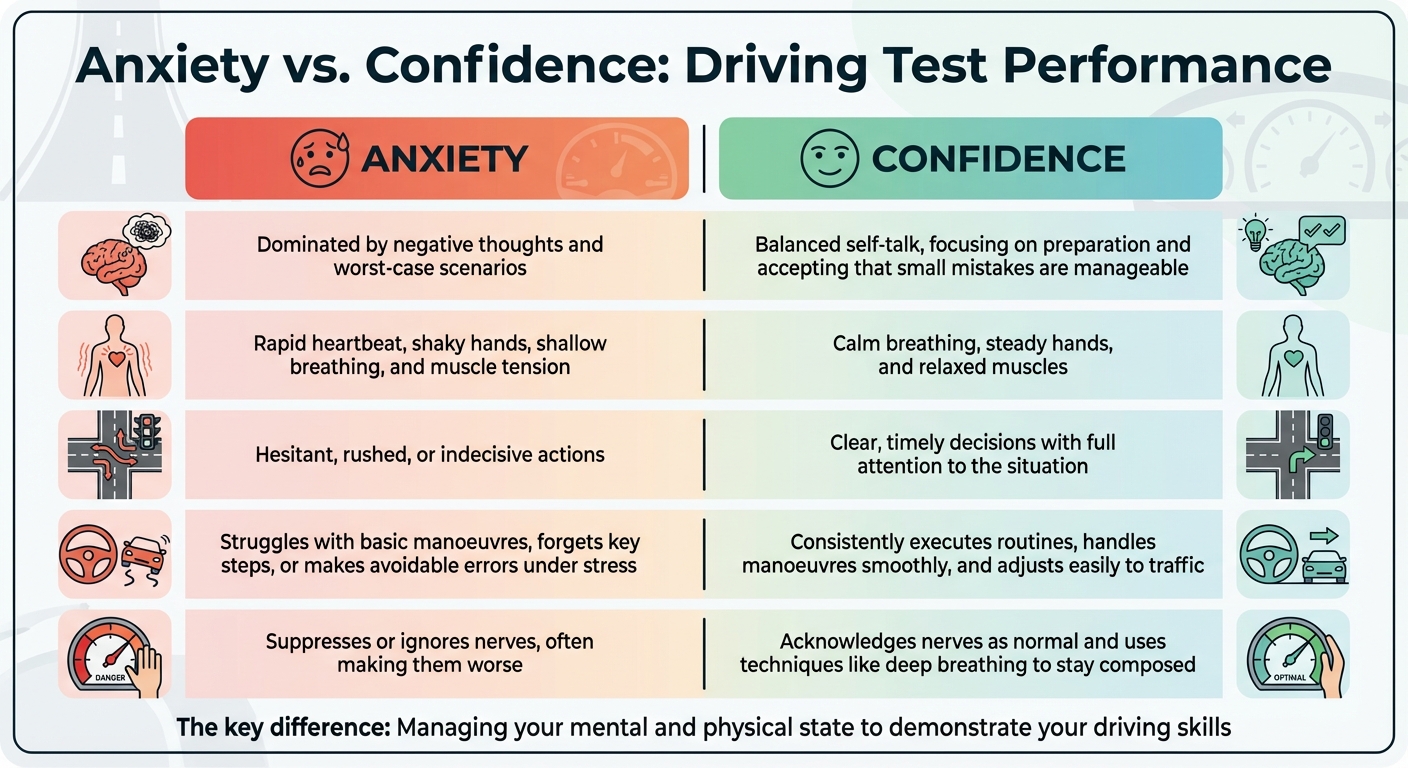
Driving Test Anxiety vs Confidence: Key Differences Comparison
Comparison Table
Understanding how anxiety and confidence shape your driving test performance can make a big difference in how you prepare. The table below highlights key contrasts between these two states and how they influence your thinking, physical reactions, and overall results:
| Aspect | Anxiety During Driving Test | Confidence During Driving Test |
|---|---|---|
| Thinking Patterns | Dominated by negative thoughts and worst-case scenarios | Balanced self-talk, focusing on preparation and accepting that small mistakes are manageable |
| Physical Symptoms | Rapid heartbeat, shaky hands, shallow breathing, and muscle tension | Calm breathing, steady hands, and relaxed muscles |
| Decision-Making | Hesitant, rushed, or indecisive actions | Clear, timely decisions with full attention to the situation |
| Overall Performance | Struggles with basic manoeuvres, forgets key steps, or makes avoidable errors under stress | Consistently executes routines, handles manoeuvres smoothly, and adjusts easily to traffic |
| Response to Nerves | Suppresses or ignores nerves, often making them worse | Acknowledges nerves as normal and uses techniques like deep breathing to stay composed |
The real difference lies in how your mental and physical state allows you to demonstrate your driving skills. Recognizing these contrasts can help you fine-tune your mindset and strategies before stepping into the car on test day.
sbb-itb-43e39f6
How to Move from Anxiety to Confidence
Shifting from anxiety to confidence isn’t about completely erasing nerves - it’s about learning how to manage them so your abilities can shine through. The secret? A solid preparation routine that trains both your mind and body, turning test day into just another practice run. Let’s dive into some practical steps to help you make that shift.
Practice Consistently to Build Skills
Confidence comes from preparation, and preparation comes from consistent, focused practice. Instead of cramming long sessions right before your test, aim for three to five practice drives per week, each lasting 30–60 minutes. This steady approach helps you develop the muscle memory needed for tasks like mirror checks, signalling, and speed control - making them second nature.
Familiarity with the test route is another game-changer. When you’ve driven through the same intersections, school zones, and lane changes multiple times, they stop feeling intimidating and start feeling routine. Tools like Drive Test Routes can help, offering GPS-based test routes for $14.99 CAD each. These routes let you rehearse on the actual roads, with real speed limits and traffic patterns. As Sarah J. from Oakville shared after passing her G2 test:
"The navigation routes were extremely helpful to me. In my drive centre, I had two routes, so I practised them both to check out signs, road markings, etc., so I felt more comfortable on the test."
To track your progress, keep a simple log. Note the date (YYYY-MM-DD format), location, skills practised, and give yourself a quick self-rating. This helps you and your instructor spot areas that need extra work, like parallel parking or three-point turns. Once you’re comfortable with the basics, gradually challenge yourself with more complex scenarios.
Use Gradual Exposure Methods
Building confidence doesn’t mean jumping straight into high-pressure situations. Instead, use gradual exposure to ease into tougher challenges. Start small: sit in the parked car and practise breathing exercises until you feel calm. Then, move on to quiet residential streets with a trusted instructor, focusing on simple turns and stops at controlled intersections.
As you gain confidence, practise manoeuvres like parallel parking, roadside stops, and three-point turns in low-pressure areas. From there, work your way up to busier roads, multi-lane traffic, and eventually full-length mock tests. These practice tests should mimic the real exam as closely as possible, including timing and instructions. Repeated exposure helps your nervous system adapt, teaching you that these situations are manageable. Avoidance, on the other hand, only keeps the fear alive.
Pairing this exposure with mental strategies, like affirmations or breathing techniques, can further solidify your preparation.
Replace Negative Thoughts with Positive Ones
Your mindset has a huge impact on your performance. Start by paying attention to anxious thoughts during practice and writing them down. For example, if you catch yourself thinking, "If I stall, I’ll fail", counter it with something like, "Minor mistakes are normal; I can recover safely."
Turn these reframed thoughts into affirmations you can repeat before and during drives. For instance:
- "I know the rules; I can handle this step by step."
- "I focus on driving safely, not perfectly."
With regular practice, this habit rewires your brain to lean toward realistic, confidence-boosting thoughts instead of worst-case scenarios. Combine these affirmations with physical techniques, and you’ll be better prepared for test day.
Try Breathing and Visualization Techniques
Calming your body is just as important as calming your mind. One effective method is 4–2–6 breathing: inhale for 4 seconds, hold for 2, and exhale for 6. Repeat this cycle 5–10 times. The extended exhale helps activate your parasympathetic nervous system, which reduces symptoms like trembling and a racing heart.
Pair this with visualization exercises. Picture yourself arriving early at the test centre, feeling a little nervous but in control. Imagine doing your breathing exercises, greeting the examiner confidently, adjusting your mirrors and seat, and starting smoothly. Walk yourself through stop signs, lane changes, school zones, and parking, all while hearing yourself respond calmly to instructions. Even visualizing minor mistakes, like a missed turn, can help you mentally practise staying composed and correcting them safely. Finish by imagining yourself parking at the end and receiving positive feedback.
Regularly rehearsing these scenarios trains your brain to associate the test with a sense of calm and success, rather than fear or failure.
How Drive Test Routes Builds Confidence
Test anxiety often comes from not knowing what to expect - uncertainty about the roads, intersections, or manoeuvres can make the process feel overwhelming. That’s where Drive Test Routes steps in. For just $14.99 CAD per centre, you can download GPS-based routes tailored to specific DriveTest Centres across Canada, giving you a clear plan for your practice sessions.
These routes integrate seamlessly with Google Maps Navigation, offering turn-by-turn directions that replicate the actual examiner routes. You’ll practise on the same intersections, speed zones, school areas, and lane changes that you’ll encounter on test day. Each practice run turns confusing turns and tricky spots into familiar territory. As Jasprit S. from Brampton shared:
"The map provided enabled me to drive around the test routes in advance... And I passed!!!. I would easily recommend this product, it was well worth the price."
To make your preparation even more effective, Drive Test Routes includes examiner-style mark sheets. These sheets reflect what assessors score - like speed control, positioning, and manoeuvres - allowing you to track your progress during mock tests. By identifying areas for improvement, such as mirror checks or lane positioning, you’ll replace self-doubt with confidence. Studies show that structured practice on familiar routes can significantly reduce test anxiety, helping you face test day with the mindset of “I’ve done this before.”
At $14.99 CAD, this preparation is a small investment compared to the cost of extra lessons or failed retests. Many learners find that practising with these routes not only saves money but also reduces the time spent stressing over the unknown. By turning uncertainty into preparation, Drive Test Routes helps you move from anxious learner to confident, independent driver.
Conclusion
Closing the gap between anxiety and confidence on test day boils down to mastering both your mental and physical responses. Your performance isn't just about knowing the rules of the road; it’s about maintaining focus, staying composed, and making clear decisions under pressure. Anxiety can lead to self-doubt, scattered thoughts, and physical tension, which often result in mistakes like missing signs, forgetting mirror checks, or over-correcting. On the other hand, confidence brings steady breathing, a relaxed grip, and the clear-headed focus needed for smooth speed control, sharp observation, and safe navigation. Studies show that heightened stress on test day significantly raises the chance of errors because it narrows focus and can lead to panic.
The goal isn’t to eliminate nerves entirely - some level of nervousness is natural. Instead, the aim is to manage that anxiety so you can showcase the skills required by Canadian licensing authorities. Confident drivers trust their abilities and adapt to challenges, whether it’s a busy intersection or unpredictable weather. It’s important to remember that examiners prioritize safe, consistent driving over perfection. By treating the test as just another drive - an opportunity to demonstrate what you’ve practised - you can shift your mindset from “What if I fail?” to “How do I drive safely in this moment?”
Confidence grows through repetition. Regular practice in real traffic, gradually tackling more challenging scenarios, and replacing thoughts like “I always panic” with “I’ve handled this situation before” can make a big difference. Simple techniques like slow, deep breathing and quick visualisation before starting the car can also help you stay calm. Pair these mental strategies with practical preparation - like practising on GPS-guided test routes that mimic your exam conditions, such as those provided by Drive Test Routes - and you'll turn uncertainty into readiness. Every confident driver started as a nervous learner, and the transformation happens through consistent practice and mental preparation. Each session on the road moves you closer to walking into the test centre feeling composed and ready to earn your licence.
Take small, actionable steps: schedule two practice sessions, replace one negative thought with a positive one, and practise a one-minute breathing routine before every drive. With focused preparation and the right mindset, driving test anxiety becomes something you can manage, paving the way for calmer, more confident drives.
FAQs
How can I overcome anxiety and build confidence for my driving test?
To go from nervous to confident before your driving test, preparation is everything. Using tools like pre-planned test routes can help you get comfortable with the roads, intersections, and traffic patterns you’re likely to face. The more you practise, the more familiar everything becomes, and that familiarity can work wonders in easing your nerves.
It’s also important to keep yourself calm. Try deep breathing exercises and use positive self-talk to stay in the right frame of mind. Make sure you’ve reviewed all the road rules, practised essential driving skills, and, most importantly, had a good night’s sleep before the big day. Feeling ready and steady can truly set you up for success.
What are the physical signs of anxiety during a driving test?
Physical signs of anxiety during a driving test often show up as an increased heart rate, sweating, trembling, a dry mouth, or even nausea. Some people might also feel dizzy or unusually restless.
The key to managing these symptoms is first to recognize them. Once you do, preparation and practice can make a big difference. For instance, getting comfortable with the test environment ahead of time can help you feel more at ease and boost your confidence.
How can breathing and visualisation techniques help you stay calm during a driving test?
Managing stress during your driving test can be a challenge, but breathing and visualisation techniques can make a big difference. Controlled breathing is a simple yet powerful way to calm your nerves. By focusing on steady, deep breaths, you can settle your thoughts and keep your body relaxed, which helps prevent tension from interfering with your performance.
Visualisation is another helpful strategy. Picture yourself confidently and successfully completing the test - this mental rehearsal can boost your confidence and prepare your mind for what’s ahead. When combined, these techniques can help you stay composed and in control, giving you a better shot at passing on your first attempt.