

DriveTest centres in Ontario are key to earning your licence, but strict rules apply. Here's what you need to know:
- Booking & Rescheduling: Book online, by phone, or in person. Changes or cancellations must be made at least 48 hours in advance to avoid losing your fee.
- Arrival Time: Arrive 30 minutes early. Being more than 15 minutes late means cancellation and losing your fee.
- Required Documents: Bring your valid licence, vehicle registration, insurance, and a printed test confirmation.
- Vehicle Standards: Ensure your vehicle meets safety requirements (working lights, horn, clean interior). Issues like cracked windshields or warning lights can cancel your test.
- Test Rules: No passengers or recording devices allowed during the test. Follow all instructions carefully to avoid failure.
- Weather Cancellations: Severe weather may cancel tests; check updates online or by phone.
Planning ahead and preparing your vehicle and documents can save you time and money. For extra practice, consider using tools like Drive Test Routes to rehearse test routes.
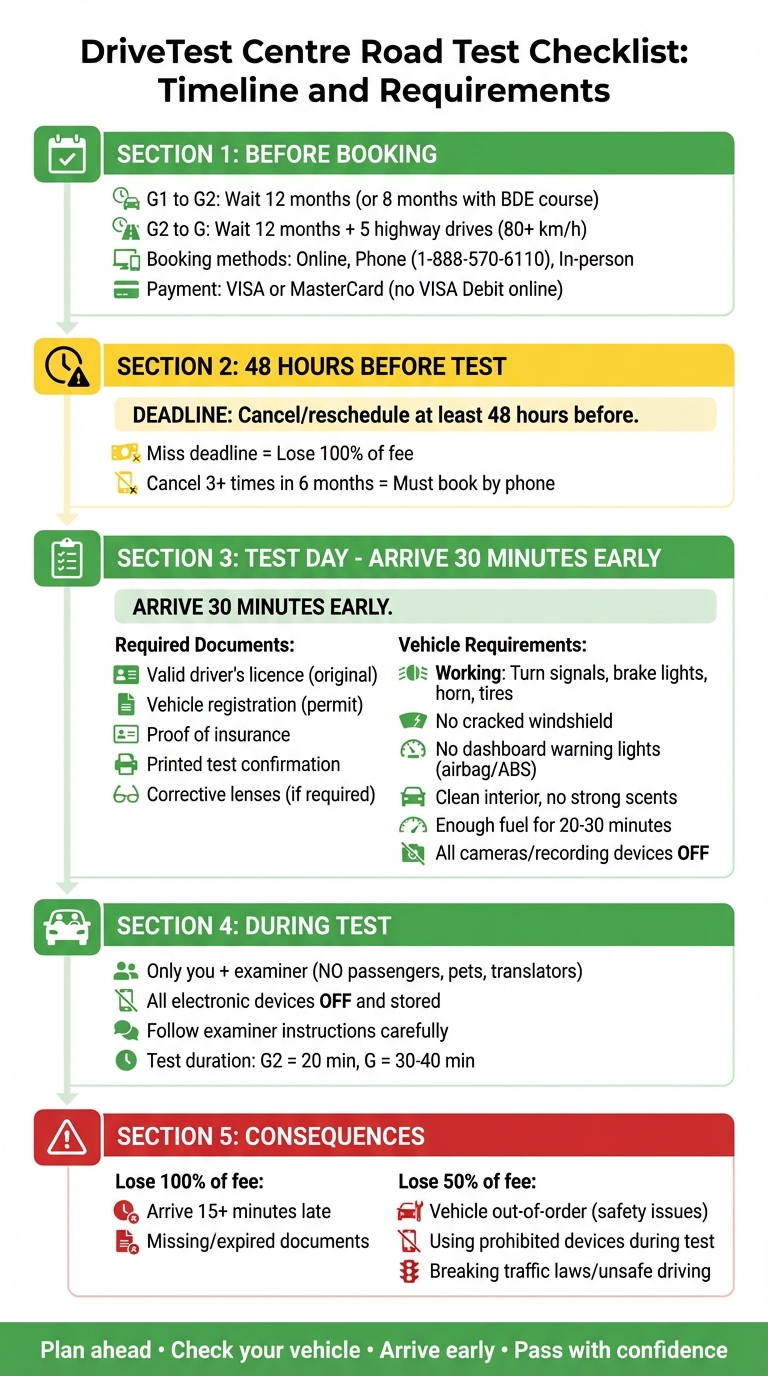
DriveTest Centre Road Test Checklist: Timeline and Requirements
Booking and Rescheduling Your Road Test
How to Book, Change, or Cancel Your Appointment
You can book, reschedule, or cancel your road test online, by phone (1-888-570-6110 or 647-776-0331), or in person. To do so, you'll need your valid driver's licence number, its expiry date, and payment via VISA or MasterCard - note that VISA Debit is not accepted online.
Keep the 48-hour rule in mind. If you need to make changes or cancel your appointment, you must do so at least 48 hours before your scheduled time. Missing this deadline means losing your entire fee - no exceptions. If your licence is expired, suspended, or flagged for reasons like medical or age-related referrals, you'll need to book by phone or in person.
Also, be aware that if you cancel more than three tests within six months, you'll have to book your next appointment by phone or in person.
When to Arrive and How to Check In
Once you've booked, punctuality is key. Arrive 30 minutes before your scheduled test time. This gives you enough time to park and check in, either at a self-serve kiosk or with an agent inside the testing centre. Remember, simply waiting in your car won’t work - the examiner won’t know you’re there unless you check in inside first.
If you’re more than 15 minutes late, your appointment will be cancelled, and you'll lose your fee. On the other hand, if your examiner hasn’t come to your vehicle within 30 minutes of your scheduled time, head back inside and visit Counter A for assistance.
Who Can Come With You
When planning your road test, keep in mind who can accompany you. No passengers or pets are allowed in the vehicle during the test itself. However, a translator or driving instructor may assist during check-in and the post-test debrief, if allowed. If you don’t pass, make sure you’ve arranged another way to get home ahead of time.
Lastly, ensure all dashboard cameras and recording devices are turned off before your test begins.
Vehicle and Document Requirements
Documents You Must Bring
Make sure to bring your original, valid driver's licence. You'll also need the vehicle registration (permit) and proof of valid insurance for the car you plan to use. If you're driving a car-sharing vehicle, don't forget the original authorization letter on company letterhead.
A printed copy of your road test confirmation is also required. If your licence includes a condition for corrective lenses, be sure to wear your glasses or contact lenses during the test. In Ontario, new applicants must provide original documents that verify their legal name and full date of birth. In British Columbia, you'll need one primary and one secondary piece of ID.
Once you have all your documents ready, double-check that your vehicle meets all safety and operational standards.
Vehicle Standards and Safety Requirements
Before the test begins, the examiner will perform a basic vehicle inspection. This includes checking that your turn signals, brake lights, horn, and tyres are in proper working condition. Keep in mind that temporary spare tyres (donuts) are not allowed. The windshield should be clear of large cracks, and all seatbelts must function properly. Warning lights for airbags or ABS on the dashboard will result in issues, as will doors that cannot open or close from both the inside and outside.
Additionally, your vehicle's interior should be clean and scent-free. Examiners may refuse to proceed if the car is excessively cluttered or poses a health risk. Make sure you have enough fuel or electric charge to complete the 20–30 minute test. Lastly, disable any dashboard cameras or recording devices before the test begins.
Why Tests Get Cancelled
If your vehicle doesn't meet the Ministry's safety standards, your test will be cancelled as "out-of-order", and you'll lose 50% of your road test fee. The remaining half will stay as a credit for a future booking. Issues like non-functional brake lights, turn signals, or horns, cracked windshields, or unsafe tyres will lead to cancellation.
Missing or expired documents will also result in the test being cancelled. For Ontario's Class G road test, you're required to declare that you've driven on highways with speeds of at least 80 km/h at least five times in the last three months. Failing to meet this requirement will also cost you half of your test fee.
Rules During Your Road Test
Passenger and Equipment Restrictions
During your road test, only you and the examiner are allowed in the vehicle - no passengers, translators, children, or pets are permitted. This ensures a distraction-free environment for the test.
All electronic recording devices must be turned off before the test begins. This includes cell phones, dashboard cameras, action cameras, and any audio or video recording equipment. Additionally, GPS systems and other electronic devices must be disabled and securely stowed away. If you’re driving a commercial vehicle with non-disableable video telematics, you’ll need to confirm with the examiner that the device is inactive.
Using any prohibited device during the test will result in immediate cancellation, and you’ll lose 50% of your test fee. To avoid any issues, it’s best to disable and store all devices before the examiner approaches your vehicle.
What Examiners Do During the Test
Once your vehicle and documents have been checked, the examiner will outline the test procedures. They may also ask if you wear corrective lenses or have any medical conditions (like epilepsy or heart disease) that could affect your ability to drive safely.
During the test, the examiner will give clear directions for tasks like making turns, stopping, changing lanes, and parking. Their role is to observe how you handle these tasks and ensure you’re driving safely. It’s important to follow their instructions carefully and focus on maintaining safe driving practices. Keep in mind that breaking traffic laws, driving unsafely, or putting others at risk - such as pedestrians or other drivers - will lead to the test being stopped immediately, resulting in an automatic failure.
At the end of the test, the examiner will provide your results on the spot.
What Happens After the Test
Once your road test is over, the examiner will share your results and offer feedback on your performance. If you don’t pass, take the opportunity to ask about specific areas where you can improve. Whether you pass or not, this feedback is a valuable tool to help you prepare for future driving challenges - or your next test, if needed.
sbb-itb-43e39f6
Location-Specific Rules and Local Factors
Site-Specific Procedures at Different Centres
DriveTest centres across Ontario don’t all operate the same way, so it’s important to know what to expect at your location. For instance, centres like Brampton and Metro East offer remote check-in systems, letting you join the queue electronically before you even arrive. If you're planning to take a commercial class test (A, B, C, D, E, F, or Z), double-check the exact test location. Starting September 1, 2025, commercial tests will take place at specific locations: Bird's Moving and Storage (10 Seapark Dr.) in St. Catharines, the Hiawatha Horse Park parking lot (1730 London Line) in Sarnia, and 600 Shannon Rd. in Sault Ste. Marie.
Motorcycle riders should also confirm their test site. For example, M2 tests in Sault Ste. Marie are conducted at St. Mary's Ukrainian Catholic Church parking lot, located about seven minutes away from the main centre. Keep in mind that only certain centres provide Saturday service, and local weather conditions can sometimes disrupt testing schedules.
Weather Cancellations and Rescheduling
Ontario winters can be harsh, and severe weather like snowstorms or freezing rain may lead to test cancellations. If your test is cancelled by the DriveTest centre due to dangerous weather, don’t cancel your appointment online - doing so could risk losing your prepaid fee. Instead, the centre will cancel it for you, and you’ll be able to reschedule at a later time.
However, if the centre remains open but bad weather makes it impossible for you to attend, you’ll need to reschedule within three business days. Waiting longer could mean you’ll need to provide proof of the extreme weather, such as a local newspaper article from the test date. For updates on cancellations, visit the Service Disruptions page on the DriveTest website or call 1-888-570-6110.
Practising Your Test Centre's Routes
Familiarizing yourself with your test centre’s routes can make a big difference on test day. Every DriveTest centre uses specific routes with unique turns, speed limits, and road conditions. Practising these routes in advance can help you feel more prepared and less anxious. A helpful resource for this is Drive Test Routes (https://drivetestroutes.com), which offers downloadable GPS-based road test routes for $14.99 CAD. These maps integrate with Google Maps and include examiner mark sheets and practice sheets, making preparation straightforward and effective.
One last thing to keep in mind: your prepaid road test fee is valid for six years from the date of payment, so you have plenty of time to practise and book your appointment when you’re ready.
Special Cases and Licensing Stages
When it comes to driver testing, certain situations and licensing stages come with extra requirements tailored to specific groups of drivers.
G1, G2, and Other Licensing Stages
Ontario’s graduated licensing system has clear timelines for each stage. If you have a G1 licence, you’ll need to wait 12 months before taking your G2 road test. However, completing a ministry-approved Beginner Driver Education (BDE) course can shorten this wait to 8 months. After earning your G2, you must hold it for another 12 months before becoming eligible for the full G test. Before attempting the full G test, you’ll need to sign a "Declaration of Highway Driving Experience", confirming that you’ve driven on highways with speeds of 80 km/h or more at least five times in the past three months. The G2 test takes about 20 minutes, while the full G test lasts 30–40 minutes and includes highway driving.
Next, let’s look at how licence transfers simplify the process for newcomers to Ontario.
Transferring Licences From Other Provinces or Countries
If you’re moving to Ontario from another province, a U.S. state, or a country with a reciprocal agreement (like Australia, France, Germany, Japan, South Korea, or the UK), you can exchange your licence without taking a road test - provided you have at least 2 years of driving experience. New residents can use their existing licence for up to 60 days before applying for an Ontario licence. If you have less than 2 years of experience, you’ll be issued a G2 licence and can take the full G test once you’ve accumulated a total of two years of driving experience.
For drivers from non-reciprocal countries, the process starts with Ontario’s Graduated Licensing System. If you have at least 1 year of driving experience, you can skip the G1 waiting period. With 2 or more years of experience, you may take the full G test directly, provided you present a Letter of Authentication. If you fail the full G test, you’ll need to pass the G2 road test before trying again. Regardless of your driving background, all applicants must pass a vision test at a DriveTest Centre.
Commercial and specialty licences come with their own set of rules and requirements.
Commercial and Specialty Licence Classes
Applying for a commercial licence involves additional steps. For a Class A licence, you must first complete mandatory entry-level training (MELT). And since July 1, 2022, the test must be taken in a vehicle with a manual transmission (featuring at least eight forward gears and a high-low range) if you want to avoid a manual transmission restriction on your licence. You’ll also need a valid medical certificate and must submit periodic medical reports - annually if you’re 65 or older, and every five years if you’re under 46.
For Class D licences with an RV restriction (Condition Q), you’ll need to complete a Recreational Vehicle Learning Module and take your road test in an RV weighing at least 14,000 kg. This rule takes effect on July 1, 2025. Commercial applicants should arrive at least 30 minutes early for their test and cancel at least 48 hours ahead of time to avoid losing 50% of their test fee.
Motorcycle licences follow a separate graduated system (M1, M2, M), and commercial licences from the U.S. or other countries are typically only exchangeable for a Class G passenger vehicle licence.
Conclusion
Abiding by test centre rules is key to protecting your investment and ensuring a fair evaluation. Keep in mind, if your vehicle has faulty equipment or you arrive late, your test could be declared "out-of-order", and you'd lose 50% of your fee.
To avoid any hiccups, check your vehicle ahead of time - make sure the lights, horn, and tyres are in good working order. Plan to arrive at least 30 minutes early with your driver's licence and any required corrective lenses. Don’t forget to disable dashboard cameras and recording devices, and ensure there are no unauthorized passengers in your vehicle. For Class G tests, you’ll need to confirm your highway driving experience - at least five trips on roads with speeds of 80 km/h or higher in the past three months.
Practising the specific routes used by your local DriveTest Centre can make a world of difference. Familiarity with local speed limits, intersections, and traffic patterns can turn test-day nerves into confidence. Services like Drive Test Routes offer downloadable GPS-based practice routes for $14.99 CAD. These routes work with Google Maps navigation, letting you rehearse the actual exam paths and tackle tricky spots beforehand. This kind of preparation allows you to focus on showcasing your safe driving skills without worrying about navigation.
Your test results are valid for 12 months, and you’ll need to wait at least 10 days before reattempting if you don’t pass. By understanding and following all the procedures - from booking your test to handling the follow-up - you set yourself up for the best chance of success. Nail these steps, and you’ll be well on your way to earning your licence.
FAQs
What should I do if my road test is cancelled due to bad weather?
If your road test gets cancelled due to severe weather, head over to the DriveTest Service Disruptions page for the latest updates. Once the centre is back in operation, you can reschedule your test online or by contacting DriveTest directly. Another option is to visit a different test centre to book a new appointment.
Weather-related cancellations are all about keeping you safe, so staying informed and adjusting your plans is key.
Can I use a rental or car-sharing vehicle for my road test in Canada?
Yes, you can use a rental or car-sharing vehicle for your road test, but it has to meet all the Ministry of Transportation requirements. This includes being in good working condition, having proper insurance, and being equipped with essential features like a functional emergency brake that the examiner can easily access.
If the vehicle doesn’t meet these standards, the examiner might cancel your test, and you could lose 50% of the test fee. To avoid any problems, double-check that the vehicle complies with all regulations beforehand.
What happens if I arrive late for my road test appointment?
If you're late for your road test, you risk losing your appointment and forfeiting the test fee. Most drive test centres require you to check in at least 30 minutes before your scheduled time to complete the necessary processing. Arriving past this window could result in your test being cancelled, meaning you'd have to reschedule and pay the fee again.
To avoid this hassle, plan your trip carefully and give yourself extra time to reach the test centre. This is especially important if you're not familiar with the area or expect traffic delays. It’s also a good idea to practise the test route beforehand to boost your confidence and help you feel prepared on the big day.