

The G2 and G road tests in Ontario are designed to evaluate different driving skills. The G2 test focuses on basic city driving, while the G test emphasizes highway driving and advanced techniques. Many drivers fail due to small, avoidable mistakes rather than poor driving skills. Common issues include:
- G2 Test Mistakes: Missing blind spot checks, rolling stops, poor lane positioning, and driving too slowly or too fast. Examiners expect clear shoulder checks, full stops at signs, and strict lane discipline.
- G Test Mistakes: Slow highway merging, improper speed control, and inadequate observation. Drivers must merge confidently, maintain traffic speed, and scan mirrors and blind spots regularly.
Each test costs $91.25, and failing can lead to additional fees and delays. Preparing by practising specific routes and addressing common errors can greatly improve your chances of passing.
Quick Comparison:
| Mistake Type | G2 Test Context | G Test Context | Prevention Strategy |
|---|---|---|---|
| Shoulder Checks | Missed during city turns or lane changes. | Skipped during high-speed merges. | Clear head turns before every movement. |
| Rolling Stops | Failing to stop fully at stop signs. | Rolling through intersections or red turns. | Stop completely for 2–3 seconds. |
| Speed Control | Driving too slow or fast in city zones. | Failing to match highway traffic speed. | Stay within 5 km/h of the posted limit. |
| Lane Discipline | Drifting or improper turns. | Abrupt lane changes or cutting off traffic. | Follow correct lane-to-lane rules. |
| Observation | Not scanning intersections properly. | Missing mirror or blind spot checks. | Regular mirror checks and deliberate scans. |
Avoid these common mistakes by practising on actual test routes, focusing on proper habits, and building confidence through repetition.
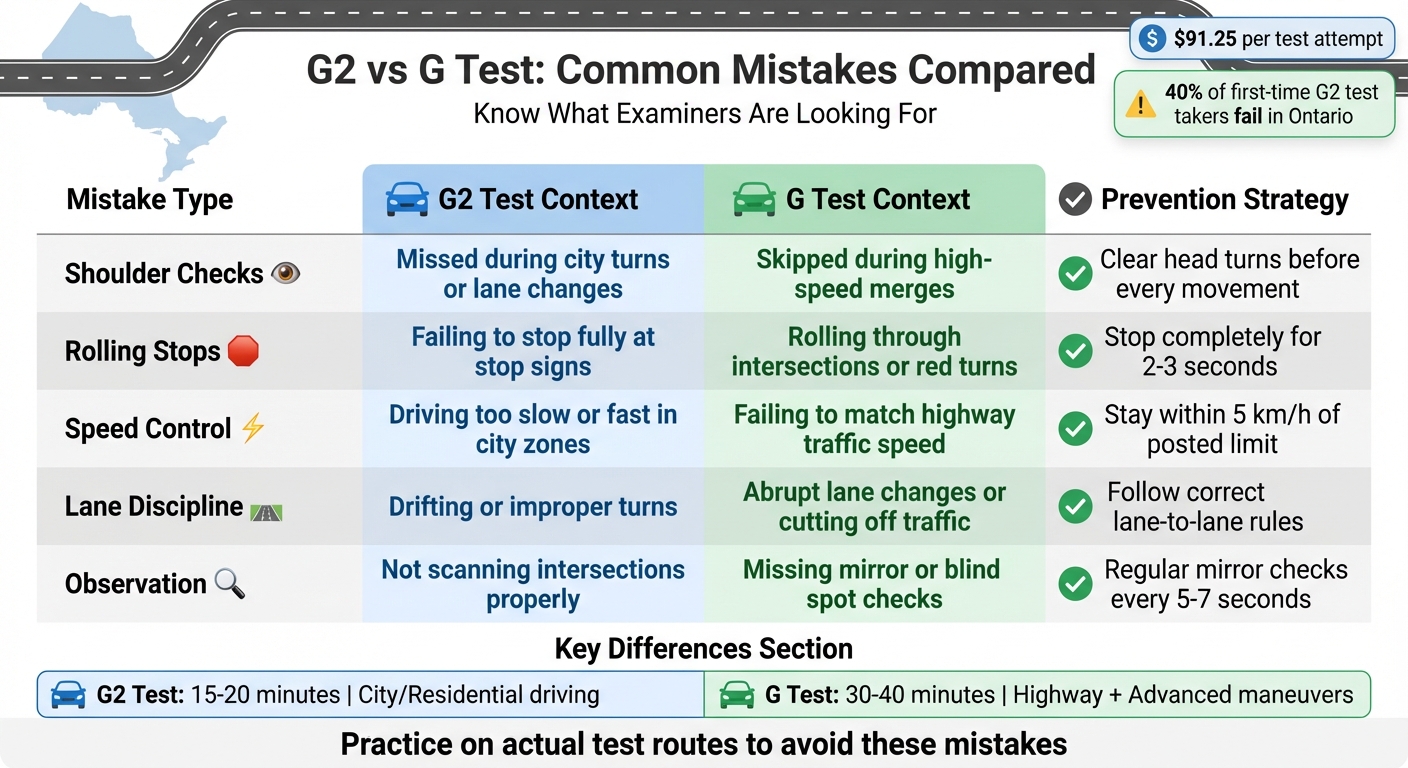
G2 vs G Test Common Mistakes Comparison Chart Ontario
Common Mistakes in the G2 Test
When taking the G2 test, certain errors pop up more often than others. Missing blind spot checks and rolling stops - where you slow down but don’t come to a full stop - are among the most common reasons for failing. Another frequent issue is poor speed control. Driving too slowly (20–30 km/h under the limit) is penalized just as heavily as speeding because it disrupts traffic flow. Examiners generally want you to stay within 5 km/h of the posted speed limit to keep traffic moving safely.
Incorrect lane positioning is another big one. Mistakes like turning into the wrong lane, drifting, or cutting corners can signal a lack of control and often lead to failure. Let’s break down some of these technical errors in more detail.
Incomplete Shoulder Checks
Turning your head to check blind spots isn’t optional - it’s mandatory. Examiners need to see you physically check the areas your mirrors can’t cover before every lane change, merge, or turn. The "Mirror + Signal + Shoulder Check" routine is your go-to for any lateral movement, even in quieter areas.
"Mirror + Signal + Shoulder Check = PASS." – BookDrivingTest.ca
Make sure your head turn is clear enough for the examiner to notice, but don’t overdo it with exaggerated movements. Keep your hands on the wheel and glance briefly over your shoulder. Practise this sequence until it feels like second nature, and make it part of your everyday driving habits - not just something you do for the test.
Rolling Stops at Stop Signs
A rolling stop - where your car doesn’t come to a complete halt - can cost you the test. To stop properly, your vehicle must be completely motionless for 2–3 seconds behind the stop line. This pause ensures the car’s weight fully transfers, confirming that the wheels have stopped moving. After stopping, wait for about two seconds before checking traffic and proceeding. This not only shows control but also demonstrates defensive driving. Skipping this step is legally considered the same as failing to stop.
Poor Lane Discipline
Maintaining proper lane positioning is critical. Stay centred in your lane and use your mirrors to avoid drifting toward the curb or the centre line - either mistake suggests poor control. Follow "lane-to-lane" discipline, which means staying in the correct lane during turns. For example, stay in the right lane after a right turn and the left lane after a left turn unless signs or markings indicate otherwise.
When making a left turn, position your car at the centre of the intersection before turning to avoid cutting corners. For right turns, finish in the rightmost lane unless road markings direct you otherwise. Failing to follow these rules can be an automatic failure, as it puts other drivers at risk. Also, don’t forget to scan intersections in a "left-right-left" pattern before proceeding, even if the light is green. This habit shows awareness and helps prevent accidents.
sbb-itb-43e39f6
Common Mistakes in the G Test
The G test is a step up from the G2, placing a strong emphasis on highway driving and advanced traffic manoeuvres. One of the most common pitfalls? Merging onto the highway too slowly. For instance, merging at 80 km/h when the traffic is moving at 100 km/h is an automatic fail in Ontario.
Highway driving also tests your ability to maintain proper speed. Driving too far below the speed limit - outside the acceptable 5 km/h range - can be seen as dangerous. Examiners want to see you confidently driving within the flow of traffic. If the limit is 100 km/h, aim to stay between 95 and 100 km/h.
"If the examiner has to frequently tell you to speed up, you've likely failed the test." – Osama Siddique, Kruzee
Another big issue? Observation. At higher speeds, it's crucial to check your rearview mirror every 5 to 8 seconds and make deliberate head turns for blind spot checks.
"Examiners watch your head movement. You must physically turn your head to check the blind spot - using mirrors alone is not enough." – Rajput Driving School
These skills become especially critical during lane changes and merges on multi-lane highways. Below, let’s break down the key areas where mistakes often happen.
Highway Merging Errors
Merging onto a highway demands quick acceleration and precise timing. Use the entire acceleration lane to match the speed of highway traffic - around 100 km/h - before merging. Hesitating at the end of the lane or, worse, coming to a complete stop, disrupts traffic flow and is a common reason for failure.
Follow the "Signal, Check, Change" routine for every merge. Signal early to alert other drivers, make a clear shoulder check with a visible head turn, and merge decisively into a gap. A safe gap should provide at least 2 to 3 seconds of stopping space in front of and behind your vehicle. Choosing a gap that's too tight forces other drivers to brake or swerve, which is considered a critical error. Once you've merged, turn off your signal and maintain highway speed.
Speeding or Driving Too Slowly
Examiners are equally concerned about speeding and driving too slowly. While speeding is an obvious safety issue, many candidates don’t realize that driving far below the limit can also result in an automatic fail.
"Driving significantly below or above the limit is equally hazardous." – G Class Drivers
Driving too slowly disrupts traffic and signals a lack of confidence. To avoid this, develop the habit of checking your speedometer briefly every 5 to 8 seconds, rather than staring at it. On highways, keep a following distance of 3 to 4 seconds behind the vehicle ahead to give yourself room to react. Adjust your speed for conditions like rain, but avoid excessive caution that could disrupt traffic flow.
Inadequate Observation at Intersections
Observation errors are the number one reason candidates fail road tests in Ontario, and the G test is no exception. Intersections, on-ramps, and off-ramps demand careful scanning. Even if the light is green, always scan left, right, then left again before entering an intersection.
"The rule of thumb for road tests is to always keep your head on a swivel." – Osama Siddique, Kruzee
Make your head movements obvious so the examiner can see you're scanning. Since they can’t detect subtle eye movements, a clear turn of the head is essential. Pay attention to pedestrians near crosswalks, not just those already crossing. If possible, make eye contact to confirm mutual awareness.
"Missing a single shoulder check at the wrong moment can result in failure, even if you drove perfectly otherwise." – Steer-and-Go
Regularly scanning your mirrors and surroundings - even when driving straight - shows situational awareness and separates confident drivers from hesitant ones.
G2 vs G Test Mistakes: Side-by-Side Comparison
The G2 test focuses on mastering basic city driving, while the G test evaluates your ability to handle more advanced highway scenarios. The G2 test is shorter, lasting about 15–20 minutes in residential areas, whereas the G test is more extensive, running 30–40 minutes and including 400-series highways. Knowing the common mistakes for each test can help you better prepare and avoid errors. Here's a breakdown of the key differences and how to address them.
Mistakes in the G2 test often stem from foundational driving skills, such as proper stops and shoulder checks. On the other hand, errors in the G test tend to involve high-speed decision-making and confidence, like merging onto Highway 401 without matching traffic flow.
"The most common mistake student drivers make during their road test is either failing to complete a proper blind spot shoulder check every time they signal, or impeding traffic by being too cautious or unsure of themselves." – Scott McQuaid, Driving Instructor, First Route Driving School
Below, you'll find a comparison table highlighting typical errors for each test and practical strategies to avoid them.
Comparison Table
| Mistake Type | G2 Test Context | G Test Context | Prevention Strategy |
|---|---|---|---|
| Shoulder Checks | Missing blind spot checks during city turns or lane changes. | Skipping blind spot checks during high-speed merges or lane changes. | Perform a clear, physical head turn before every lane change or turn. |
| Rolling Stops | Failing to stop completely at stop signs in residential areas. | Rolling through busy intersections, especially when turning right on red. | Stop fully behind the white line, count to two or three, and feel the car "settle." |
| Speed Control | Driving too slowly out of nervousness or speeding in school zones. | Not reaching highway speeds on ramps or exceeding limits on expressways. | Stay within 5 km/h of the posted limit and match the highway flow when merging. |
| Lane Discipline | Drifting or entering the wrong lane during turns. | Making abrupt lane changes or cutting off other drivers at high speeds. | Follow "right-to-right" and "left-to-left" rules during turns and signal early. |
| Observation | Neglecting to scan left–right–left at intersections. | Failing to check mirrors and blind spots when merging or scanning traffic. | Make deliberate head movements and check mirrors every 5–7 seconds to show awareness. |
How Drive Test Routes Helps You Avoid These Mistakes
Practising on the exact roads your examiner will use can make all the difference. Drive Test Routes provides GPS-based navigation for DriveTest centres across Ontario, allowing you to follow the same paths on your phone using Google Maps. Instead of guessing where you'll be driving on test day, you’ll know every key manoeuvre in advance. Here’s how these GPS-based routes help you prepare for the unique challenges of the G2 and G tests.
Practising Actual G2 Test Routes
Downloading a G2 route for your test centre gives you turn-by-turn directions through the residential streets and city roads where your examiner will assess your skills. This means you can familiarize yourself with every four-way stop, school zone, and tricky intersection before test day. You’ll know exactly where to perform essential tasks like a three-point turn or parallel parking, and you can refine your lane discipline at critical spots. With unlimited access, you can practise the route multiple times - whether it’s a quiet Sunday morning to build confidence or a busy weekday to simulate heavier traffic.
Highway Practice for G Test Routes
The G test focuses on advanced driving skills, particularly highway merging and maintaining speed control. These GPS routes highlight acceleration lanes and merge points that examiners typically assess. Practise the "match-and-merge" technique on 400-series ramps by accelerating to 80 km/h or higher, signalling effectively, checking your blind spots, and staying within 5 km/h of the speed limit. The routes ensure you’re well-prepared for the highway portion of the test, which requires at least five highway drives in the three months leading up to your exam.
Building Confidence with GPS Routes
Familiarity with the test routes does more than improve your technical skills - it helps reduce test-day nerves. Repeatedly driving these routes makes the roads feel like second nature, allowing you to focus on good driving habits. You’ll develop the routine of checking mirrors every 5–7 seconds, using physical landmarks as cues, and making the "Signal, Check, Change" sequence automatic. At CA$14.99, these routes provide unlimited practice on the roads that matter, offering an affordable way to prepare compared to ongoing driving lessons.
Conclusion
Both the G2 and G tests present their own unique challenges, often tripping up drivers in different ways. The G2 test focuses on residential driving skills, where lane discipline and basic vehicle control are common trouble spots. On the other hand, the G test requires more advanced abilities, such as merging onto highways at speeds of 80 km/h or higher and maintaining a speed within 5 km/h of the limit - areas where hesitation or slow merging can lead to failure.
These challenges, however, are manageable with targeted preparation. As outlined earlier, practising specific manoeuvres like lane discipline, complete stops at signs, and proper highway merging can make a significant difference. Simple habits, such as consistent head checks before turns, maintaining a safe following distance of 3 to 4 seconds, and checking mirrors every 5 to 7 seconds, can turn these technical requirements into second nature. Knowing what examiners expect takes much of the guesswork out of the process and reduces test-day nerves.
Driving the actual test routes repeatedly is another key to success. Familiarity with the roads helps you anticipate tricky intersections, know which lanes to use, and handle specific merge points with confidence. This preparation allows you to focus on showcasing safe driving habits rather than worrying about unexpected surprises. Over time, these practices not only sharpen your skills but also ease the anxiety that often comes with testing.
For $14.99, Drive Test Routes provides unlimited access to GPS-based practice routes, offering a cost-effective alternative to additional lessons, which can cost $91.25 per test attempt. Considering that approximately 40% of first-time G2 test takers in Ontario fail - and face a mandatory 10-day wait to retake the test - dedicating time to route-specific practice can significantly boost your chances of passing on the first try.
FAQs
What’s the biggest difference between the G2 and G road tests?
The main distinction lies in the skills each test assesses. The G2 test measures your ability to handle basic driving tasks in city environments. In contrast, the G test evaluates more advanced abilities, including highway driving and navigating higher-speed situations. The G test demands a higher level of confidence and precision, especially when managing complex driving scenarios.
How can I make my shoulder checks obvious to the examiner?
To make your shoulder checks stand out during your driving test, turn your head in a clear and deliberate motion to check your blind spot whenever you're changing lanes, merging, or turning. Subtle glances won’t cut it - your head movement needs to be obvious to the examiner. Practise this regularly so it becomes second nature, allowing you to confidently show strong observation skills throughout the test.
How do I merge at highway speed without risking a fail?
To merge safely during your G test, make sure your speed aligns with the flow of highway traffic - ideally within 10–20 km/h of the speed limit. Keep an eye on your mirrors and blind spots to spot an opening, signal well in advance, and accelerate steadily. Avoid coming to a stop at the end of the ramp, as this can disrupt traffic and may lead to a test failure. Once you’ve merged, position your vehicle in the centre of the lane and maintain a safe distance from the car ahead. Following these steps can help you stay in control and pass your test with confidence.