

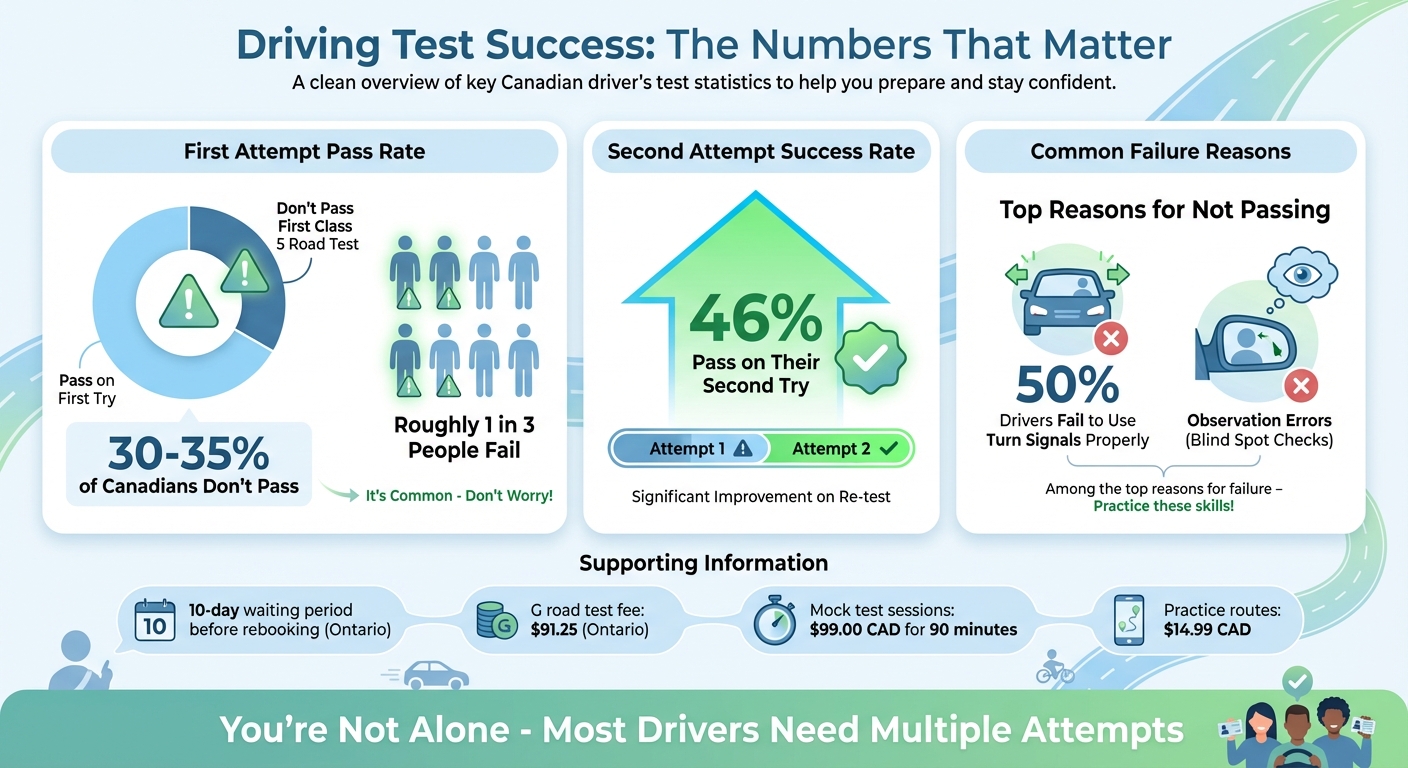
Failing your driving test can feel discouraging, but it’s a common experience - about 30-35% of Canadians don’t pass their first Class 5 road test. The good news? Nearly half (46%) pass on their second try. The key to success is addressing mistakes, improving skills, and managing test-day nerves. Here's how to move forward:
- Acknowledge your emotions: Feeling upset is normal. Take a few days to reset and process the feedback from your test.
- Learn from mistakes: Review your examiner's feedback and focus on specific areas to improve, like observation or vehicle control.
- Reframe negative thoughts: Replace self-criticism with actionable goals, such as "I’ll practise parallel parking" instead of "I’m a bad driver."
- Practise smarter: Use tools like test route maps and mock exams to simulate real conditions and build confidence.
- Prepare mentally: Techniques like visualization, positive self-talk, and breathing exercises can help you stay calm under pressure.
With focused practice and the right mindset, you can turn this setback into a stepping stone toward success.
Driving Test Statistics and Success Rates in Canada
Accept and Work Through Your Emotions
Feeling upset, frustrated, or even angry after failing your driving test is completely normal. In fact, about 30% to 35% of people don’t pass their first Class 5 road test. So, if you’re feeling down, know you’re not alone. What’s important is to not bottle up these emotions. Ignoring how you feel can make it harder to move forward and might even leave you feeling bitter about the whole process.
Take a few days to pause and reset before jumping back into practice. Giving yourself this space can help you approach your next steps with a clearer head. Talking to someone you trust - whether it’s a friend, family member, or even your driving instructor - can also help. Sometimes, just saying how you feel out loud can make the setback seem less overwhelming. After that, take some time to go over your test feedback. Pinpointing the areas you need to work on will give you a sense of direction moving forward.
Recognize Failure as Part of Learning
One failed test doesn’t define you as a driver - or as a person. It’s important to remember that your test result reflects just one moment in time, not your overall potential. A lot of people fail because of test-day nerves, which means the issue is often more about the situation than your actual driving ability.
Think of this experience as a practice run. Now you know what the test environment feels like, what the examiner is looking for, and which parts of the test you found most challenging. That’s knowledge you didn’t have before, and it can genuinely help you prepare better for next time.
Replace Self-Criticism with Constructive Thinking
It’s easy to fall into a cycle of negative self-talk after failing. But instead of saying things like, "I’m a terrible driver", try focusing on specific areas to improve: "I need to work on my parallel parking", or "I let my nerves get the better of me this time." Shifting from vague self-blame to actionable steps makes the process feel more manageable.
Here’s how you can reframe your thoughts:
| Negative Self-Criticism | Constructive Reframing |
|---|---|
| "I’m a terrible driver because I failed." | "I didn’t meet the requirements today, but I can improve my skills." |
| "I’ll never be able to pass this test." | "Now I know what to work on, and I have a plan to improve." |
| "I’m a failure for getting so nervous." | "It’s normal to feel nervous; I’ll practise techniques to stay calm next time." |
Start practising this mental shift. For example, if you catch yourself thinking, "I’ll never pass", consciously replace it with, "I’m improving every time I practise." It might feel awkward at first, but this kind of thinking helps rebuild your confidence. And with confidence, you’ll be in a better position to focus on the skills that need work and perform better on your next attempt.
Review Your Test Feedback Carefully
Your examiner’s feedback is one of the most valuable tools you have for improving your driving skills. Right after your test, the examiner will explain why you didn’t pass. Make sure to record this information immediately. This verbal explanation often includes details that go beyond the score sheet, like hesitation at intersections or forgetting to check blind spots.
Afterward, access your official score sheet online. This document breaks down the areas where you lost points. It will also indicate whether you failed due to a major fault - like rolling through a stop sign or hitting a curb - or because you accumulated too many minor faults across various categories.
Understanding these fault types is key. A major fault means you need to address a specific critical mistake, while multiple minor faults suggest a need to improve consistency across different skills. Did you know that about 46% of people pass on their second attempt? Many succeed because they use their feedback to create a focused practice plan, rather than simply spending more hours behind the wheel without a clear direction. The next step is to break down each point into actionable goals.
Break Down Feedback into Action Steps
Once you have your score sheet, transform each error into a specific practice goal. For example, if the examiner flagged "steering errors", don’t just aim to practise steering in general - plan sessions that focus on smooth turns and maintaining a steady lane position. Similarly, if "observation" was an issue, commit to checking your mirrors every 5–8 seconds and performing clear head checks for blind spots during every lane change.
Here’s a table to help translate common feedback into practical tasks:
| Examiner Feedback | Specific Practice Action |
|---|---|
| Vehicle Control | Practise smooth acceleration, steady braking, and avoiding jerky movements |
| Observation | Check mirrors every 5–8 seconds; perform head checks before lane changes |
| Signalling | Use signals at least 30 metres before turns or 5 seconds before lane changes |
| Speed Management | Pay attention to speed limit changes, especially in school zones and construction areas |
| Right-of-Way | Review yielding rules for pedestrians and four-way stops |
Write down all the mistakes noted by the examiner and create a checklist. Then, work through each item one by one. If something is unclear, ask your driving instructor for clarification - they can explain what the examiner likely observed and how you can fix it. This method turns general feedback into a clear action plan.
Focus on the Most Important Skills First
Not all errors are equally critical. Start with the skills that caused an automatic fail or resulted in the most lost points. Common automatic fails include rolling stops, hitting curbs, tailgating, and changing lanes in intersections. If any of these were flagged in your feedback, they should be your top priority.
Once major issues are addressed, shift your focus to high-stakes manoeuvres like parallel parking, three-point turns, and highway merging. These skills often carry significant point deductions and require repetition to build muscle memory. For example, research shows that 50% of drivers fail to use turn signals properly, and observation errors - like missing blind spot checks - are among the top reasons for failing a test. If these issues came up in your feedback, dedicate focused practice sessions to them.
Practise Specific Skills with Drive Test Routes
Once you've pinpointed the areas where you struggle, take your practice to the next level by simulating the actual test environment. Getting familiar with the real test routes can help you feel more at ease on exam day. Instead of worrying about navigating unfamiliar streets, you can focus entirely on showcasing your safe driving abilities. Knowing the specific intersections, school zones, and residential streets you’ll face can make all the difference.
Drive Test Routes offers downloadable GPS routes, examiner mark sheets, and practice sheets for $14.99 CAD. These tools are designed to make your preparation more effective and targeted. By practising these routes, you’ll gain confidence and a better understanding of the conditions you’ll encounter.
Get Comfortable with the Real Test Routes
Start by downloading the GPS route for your test centre and loading it into Google Maps. Practise driving the route repeatedly under different conditions - whether during rush hour, light rain, or at the same time your test is scheduled. This repetition helps you build consistent familiarity.
Pay close attention to specific challenges along the route. For example, if there’s a tricky four-way stop or a school zone with heavy pedestrian traffic, practise navigating those areas until they feel second nature. By test day, these spots won’t feel intimidating because you’ve already handled them multiple times. The more you repeat these sections, the more your confidence grows, replacing anxiety with calm readiness.
"Consistent training transforms flaws into specialties."
Monitor Your Progress with Examiner Mark Sheets
After practising the route, take an honest look at your performance. Drive Test Routes provides examiner mark sheets, which are formatted just like the ones used in the actual test. Use these during your practice drives to track your progress. You can either evaluate yourself or ask a trusted friend or family member to review your performance.
Focus on the areas where you’ve lost points in the past. For example, if "observation" has been an issue, keep track of every missed mirror check or blind spot glance. If "vehicle control" needs work, note instances of jerky steering or abrupt braking. This kind of detailed self-assessment turns your practice sessions into measurable progress. Once you can drive the route without marking any errors on your practice sheet, you’ll know you’re ready to confidently book your next test.
Run Practice Tests Under Real Conditions
Once you're familiar with the test route, it’s time to step up your preparation by mimicking the actual exam as closely as possible. Treat your practice sessions like the real deal - no pausing, no do-overs. The aim here is to build mental stamina and get comfortable with the pressure of being evaluated for a solid 30 to 40 minutes.
Practise Like It's Test Day
Try scheduling your practice sessions for the same time and day as your actual test, like 10:00 a.m. on a Tuesday, to replicate the environment. Before you start, go through a pre-test checklist: make sure your brake lights, headlights, turn signals, and windshield wipers are all functioning properly. Buckle up, turn off your phone, and remember to perform all required mirror checks and head movements.
While driving, avoid major mistakes like rolling through stop signs, following too closely, or making improper lane changes. If you slip up, don’t stop - just keep driving and review your mistakes later. This trains you to stay focused and bounce back from small errors without letting them throw you off. Practise in a variety of conditions to prepare for anything. Once you’re comfortable maintaining focus, add an observer to simulate the real pressure of a test scenario.
Get Feedback from Someone You Trust
To make your practice feel even more like the real thing, ask a trusted driver or instructor to act as your examiner. They shouldn’t offer any help - no reminders, no hints - just quiet observation. Give them a copy of the official examiner’s mark sheet and ask them to evaluate you based on the same criteria: observation, vehicle control, speed management, lane positioning, and parking skills.
Afterwards, sit down together and go over the results. Ask for detailed feedback on areas like observation, mirror use, braking, and overall driving performance. This kind of critique can help you spot patterns you might not notice on your own. If possible, try arranging a mock test with an instructor you’re not familiar with. This adds an extra layer of realism, simulating the feeling of being evaluated by someone new. Many driving schools even offer 90-minute mock test sessions for $99.00 CAD, complete with a professional evaluation and tailored coaching to help you fine-tune your skills.
sbb-itb-43e39f6
Strengthen Your Mental Preparation
Once you've sharpened your driving skills, it's time to focus on your mental game. Even the most skilled drivers can falter under pressure if their mind isn’t in the right place. Mental preparation doesn’t mean erasing all anxiety - it’s about teaching yourself to stay calm and focused when it matters most. Here are some techniques to help you build mental resilience.
Use Visualization Techniques
Take a few minutes each day to picture yourself handling the driving test with confidence. Imagine your hands steady on the wheel, smoothly checking mirrors, signalling on time, and executing each manoeuvre effortlessly. This mental practice makes the test feel familiar, almost like you’ve already done it.
Focus on visualizing the process, not just the outcome. Picture specific actions like checking blind spots, keeping a safe following distance, and staying composed at busy intersections. Pair this with deep breathing - imagine exhaling stress with every breath. This helps train your brain to associate the test environment with calm, deliberate actions. Think of the examiner as just another passenger who’s there for a safe, smooth ride - not someone waiting to catch every mistake.
These visual exercises pave the way for more effective self-talk.
Use Positive Self-Talk
The way you talk to yourself has a big impact on how you perform. Maryellen MacDonald, a professor in psychology and language sciences, points out that "talking to yourself is an excellent way to help you focus, solve problems, boost your motivation and clarify your thinking." Replace negative thoughts like "I always mess up" with affirmations such as "I’ve practised and I’m ready", or "I’ll take this one step at a time."
Using your name in self-talk can also create some emotional distance, making it easier to stay logical. For example, say, "[Your Name], you’re nervous about this lane change, but take a deep breath and check your mirrors." This approach helps you acknowledge your emotions without letting them take over. As MacDonald explains, "the more precisely people name the emotions they're feeling, the more benefit they get from talking about their emotional state."
Before starting the test, try the 4-4-4 breathing technique: inhale for 4 seconds, hold for 4 seconds, and exhale for 4 seconds. This simple exercise can help you stay centred and calm under pressure.
Get Professional Help and Rest
Sometimes, the best way to move forward is to seek guidance from someone who knows exactly what to look for. A skilled driving instructor can pinpoint habits you might not even notice and offer the focused practice you need to sharpen your skills. Pairing expert advice with proper self-care not only boosts your driving abilities but also ensures you're mentally prepared for your next test. Over-practising without giving yourself time to rest can actually hinder progress and make it harder to retain what you've learned.
Book Extra Driving Lessons if Needed
If certain manoeuvres or road situations are tripping you up, taking additional lessons can make a big difference. Professional instructors are well-versed in the latest Ministry of Transportation rules and can provide strategies tailored to your specific needs. They can quickly identify any skill gaps and recommend targeted exercises to address them before your retest.
Consider scheduling a lesson right before your test - an hour-long warm-up session can help you polish your techniques and calm your nerves. This last-minute preparation ensures you're feeling confident and ready to face the examiner.
Make Time for Rest and Self-Care
While extra lessons are great for improving your driving, rest is just as important for performing your best. A solid night's sleep can enhance your reaction time and focus. Skipping late-night cramming or over-practising the evening before your test is key to staying sharp.
The day before your test, aim for a light workout to boost your mood and reduce anxiety. Stay away from caffeine and alcohol to ensure a restful sleep. On test day, try to arrive at the testing centre 30 to 45 minutes early. This gives you enough time to relax and get into the right mindset without letting nerves take over.
Plan Your Next Test Attempt
With your skills sharpened and your mindset in a better place, it’s time to map out your next steps for a confident retest. In Ontario, there’s a mandatory 10-day waiting period before you can book another road test. Use this time wisely - it’s a perfect opportunity to focus on targeted practice. Head over to DriveTest.ca to download your official score sheet. This document is a goldmine for identifying areas like incomplete stops or missed mirror checks that need extra attention. By addressing these specific issues, you can turn past mistakes into strengths.
Create a Practice Schedule
Consistency is key. Practise driving daily to build muscle memory and boost your confidence. Make sure to drive at different times of the day and in various weather conditions to prepare for whatever test day throws at you. If you’re gearing up for the G test, carve out plenty of time for highway practice - this includes driving on roads with speed limits of at least 80 km/h, which is a critical part of the test.
Take advantage of tools like Drive Test Routes to get familiar with the routes used at your testing centre. Knowing the lay of the land can ease test-day nerves and help you anticipate tricky spots, like complex intersections or unexpected lane changes. Before booking your retest, consider a session with a driving instructor - they can give you honest feedback on your readiness and help fine-tune your schedule. Keep in mind, the G road test fee in Ontario is $91.25.
Focus on Improvement, Not Perfection
As you prepare, shift your mindset towards steady progress rather than chasing perfection. Did you know that 46% of people pass their driving test on their second try? Each practice session is a step forward. Celebrate small wins, whether it’s nailing a smooth lane change or mastering parallel parking. These little victories build up quickly and boost your confidence.
"Consistent training transforms flaws into specialties." - Drive Test Routes
Stay positive and realistic. No one expects you to become a flawless driver overnight. Instead, focus on showing safe and capable driving skills on test day. Be patient with yourself, trust the process, and approach your next attempt knowing that your hard work is setting you up for success.
FAQs
How can I stay calm and confident on the day of my driving test?
Feeling nervous before your driving test? Don’t worry - it's completely normal. The trick is to stay calm and focused so you can perform at your best. Here are a few tips to help keep those nerves in check:
- Practise, practise, practise: The more you practise, the more confident you'll feel. If possible, use the same car you'll be driving during the test. It also helps to get familiar with the test routes in advance.
- Plan your day: Double-check the test location, gather all the necessary documents, and aim to arrive 15–20 minutes early. This way, you’ll avoid the stress of rushing at the last minute.
- Sleep well the night before: Aiming for 7–8 hours of sleep can make a huge difference. Also, steer clear of caffeine or alcohol late in the evening to ensure you wake up feeling refreshed.
- Calm your mind: Deep breathing exercises can help settle your nerves before the test. Remind yourself that it’s okay to make minor mistakes - what matters most is driving safely.
With preparation and a calm mindset, you'll feel more confident and ready to tackle your driving test. You've got this!
What should I focus on improving after failing my driving test?
After not passing a driving test, it’s crucial to zero in on the specific skills your examiner pointed out. Common areas needing attention often include vehicle control (like smooth steering, braking, and acceleration), speed management (keeping within speed limits), and observation skills (such as checking mirrors, blind spots, and traffic signs early). It’s also worth dedicating time to practising reverse parking and handling intersections with confidence, ensuring you’re clear on right-of-way rules and proper signalling.
To rebuild your confidence, practise these skills in different scenarios - try driving at night, in the rain, or during heavy traffic. This will help you become more consistent and less anxious. Rehearsing on GPS-mapped test routes can also make a big difference, as it familiarizes you with the actual roads and intersections you’ll encounter during the test. Take the examiner’s feedback seriously and plan focused practice sessions to strengthen the areas where you struggled.
How can I recreate the driving test experience during practice?
To get ready for the real driving test, start by going through the feedback from your last attempt. This will help you pinpoint areas where you need to improve. Practising on GPS-based routes designed for your local Drive Test Centre is a great way to become familiar with the roads you’ll face on test day. And if possible, practise using the same vehicle you plan to drive during the test. This ensures you’re comfortable with its controls.
Try to schedule your practice sessions at the same time of day as your test. That way, you’ll experience similar traffic and lighting conditions. To make it even more realistic, ask someone to play the role of the examiner. They can observe your driving and point out any mistakes, simulating the test environment. Don’t forget to practise in different conditions, like at night or on wet roads, so you’re ready for anything. This preparation strategy can help you feel more confident and avoid surprises when it’s time for the actual test.