

Passing your driving test takes more than knowing the rules - it requires preparation and practice on the actual test routes. In Ontario, nearly 40% of first-time G2 test takers fail, often due to preventable mistakes. Here’s how to improve your chances:
- Practise on the actual test routes: Familiarity with the roads reduces anxiety and helps you focus on critical skills like mirror checks, blind-spot monitoring, and proper speed management.
- Avoid common mistakes: Rolling stops, missed blind-spot checks, inconsistent speed, and poor lane changes are frequent reasons for failure.
- Plan your practice: Spread out sessions, use mock tests with instructors, and practise at the same time of day as your test.
- Use tools like Drive Test Routes: GPS-guided routes help you practise the exact roads and conditions you'll face on test day, saving time and money.
Preparation Mistakes Before Practising Test Routes
Preparation plays a key role in shaping your driving journey. Unfortunately, many learners dive into practice without a structured plan, which can lead to wasted effort and repeated setbacks. Knowing what to avoid is just as important as mastering the right moves. Here are some common mistakes to steer clear of when preparing for test-route practice.
Skipping Mock Tests with an Instructor
Practising alone or with family may seem like a budget-friendly option, but it often leaves critical errors unchecked. Without professional guidance, you might unknowingly develop bad habits that are tough to break later. Driving instructors provide a trained, objective eye, offering feedback that family or friends might miss. Mock tests, in particular, are invaluable - they replicate the conditions of a real exam and help you understand how examiners classify faults into "driving", "serious", and "dangerous" categories. This insight is essential for avoiding automatic failures.
Statistics show that learners who combine professional lessons with family-led practice are 1.4 times more likely to pass their test. Without that professional input, you risk reinforcing incorrect techniques, making it harder to progress effectively.
Ignoring Specific Road Features on Test Routes
Test routes are designed to challenge drivers, often featuring tricky elements like intersections, stop signs, and restricted zones. Ignoring these specifics can lead to critical errors. For instance, intersections account for nearly one-quarter of all traffic fatalities, yet many learners underestimate their complexity. Common mistakes like rolling through stop signs, misjudging traffic signals, or speeding in school zones can result in automatic failures.
To prepare effectively, practise driving in the actual test area and at the same time of day as your scheduled exam. For example, if your test is at 2:30 PM, you might encounter school dismissal traffic. Practising under similar conditions helps you anticipate and adapt to the real-life dynamics you'll face during your exam.
Cramming Practice Sessions
Trying to cram all your practice into a short period is a recipe for stress and poor retention. Building driving skills takes time, and rushing the process does more harm than good. Cramming often leads to frustration and can make it harder to absorb and apply what you've learned.
In Ontario, there’s a mandatory 10-day waiting period between road test attempts, while British Columbia requires 14 days after the first failure, 30 days after the second, and 60 days for further attempts. These waiting periods exist to ensure drivers have enough time to improve their skills. Instead of cramming, spread your practice over several weeks or months. This approach allows you to develop muscle memory and confidence behind the wheel.
On the night before your test, focus on reviewing areas where you feel less confident and ensure you get a good night’s sleep. Avoid trying to learn new techniques at the last minute - it’s far better to enter your test feeling calm and prepared.
sbb-itb-43e39f6
Common Driving Errors on Test Routes and How to Avoid Them
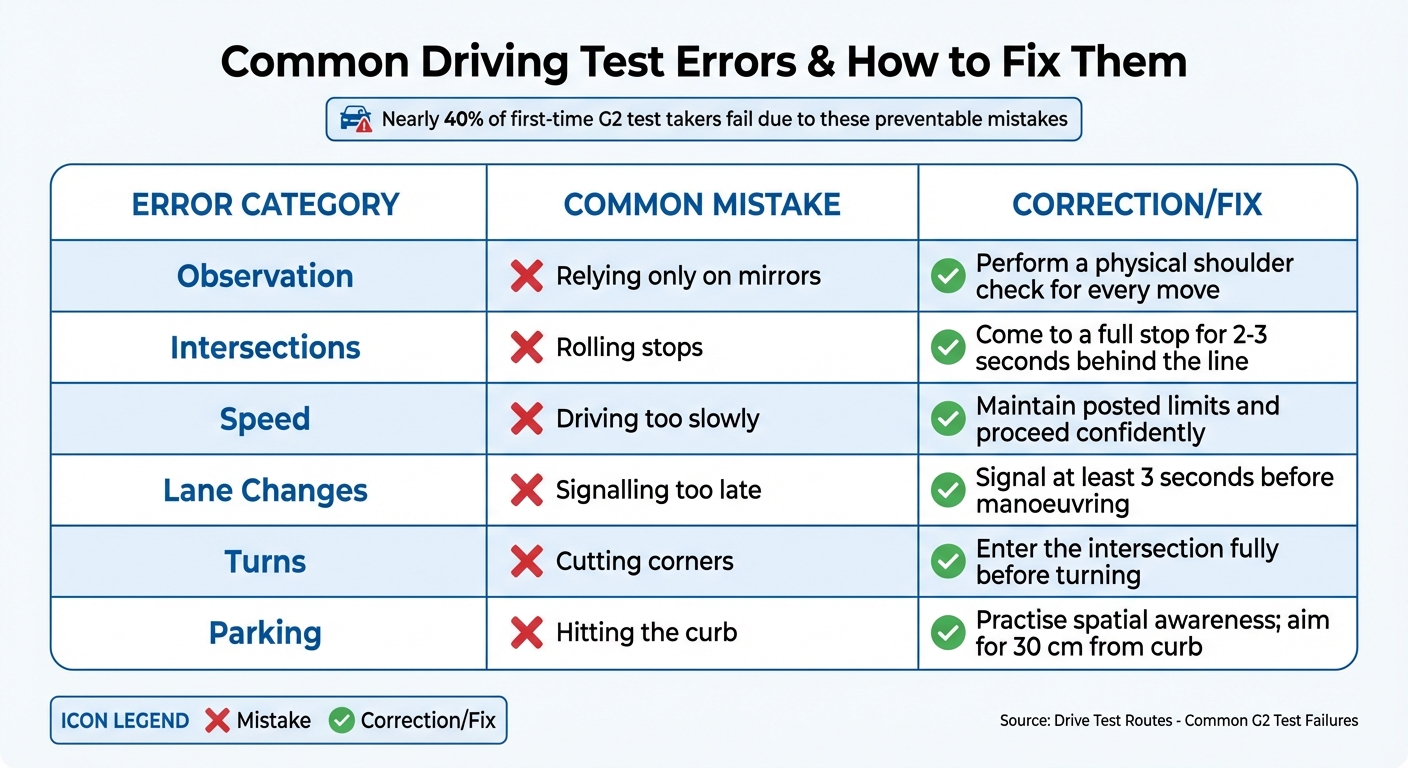
Common Driving Test Errors and How to Fix Them
Many first-time test takers stumble over a handful of recurring mistakes. Knowing what these errors are - and how to avoid them - can be the key to passing your test. Let’s break down some of the most common on-road issues and how to handle them effectively.
Incomplete or Rolling Stops at Intersections
A rolling stop happens when your car doesn’t come to a full halt, even if it slows almost to a crawl. Examiners see this as a serious issue because it’s both illegal and unsafe. A complete stop means the car is entirely motionless for 2 to 3 seconds - you’ll feel the suspension settle.
"Coming to a complete stop means your vehicle must be completely motionless for 2-3 seconds." - Steer n' Go
To avoid this, brake smoothly to a full stop behind the stop line or crosswalk. Count to three before scanning for traffic. If your view is blocked, stop fully first, then creep forward slowly to check for cross-traffic. Never start scanning while the car is still moving.
Practising stops on actual test routes will help you get comfortable with this process.
Poor Mirror and Blind-Spot Checks
Missed blind-spot checks are a frequent cause of failure. Mirrors alone can’t cover all angles, so turning your head for a shoulder check is mandatory before lane changes, merges, or turns. Examiners need to see you physically turn your head, so make it noticeable - don’t just flick your eyes.
Check your rearview mirror every 5 to 8 seconds to show awareness, and always scan before changing speed or direction. At intersections, even with a green light, look left, centre, and right to spot unexpected pedestrians or cyclists.
Inconsistent Speed Management
Driving too slowly can be just as problematic as speeding. Going well below the limit creates traffic hazards, frustrates other drivers, and signals hesitation to your examiner. Stick to the posted speed limit unless conditions like rain, construction, or school zones require you to slow down. When merging, accelerate smoothly to match traffic flow and maintain steady control when you have the right of way.
Following Too Closely (Tailgating)
Keeping a safe following distance is critical for avoiding rear-end collisions and demonstrating good judgement. Use the 4-second rule: pick a fixed object ahead, like a sign. When the car in front passes it, count "one-thousand-one, one-thousand-two, one-thousand-three, one-thousand-four." If you reach the object before finishing the count, you’re too close. In wet or icy conditions, increase this to 6 seconds or more.
Improper Lane Changes and Turns
Common errors include failing to signal, drifting between lanes, or turning into the wrong lane. Always signal at least 3 seconds (or about 30 metres) before making a move, check mirrors and blind spots, and complete the manoeuvre cleanly.
For right turns, finish in the rightmost lane. For left turns, enter the intersection fully before starting the turn to avoid cutting the corner.
Parking Errors on Test Routes
Parallel parking can trip up many learners, especially if they hit the curb or park too far from it. Aim to finish within 30 cm (about one foot) of the curb without touching it. If you do hit the curb, calmly pull forward and readjust.
When hill parking, turn your wheels correctly: towards the curb when downhill and away from the curb when uphill. Always scan your surroundings while reversing by checking mirrors and performing shoulder checks to stay aware of pedestrians, cyclists, and vehicles.
Distracted or Overcautious Driving
Even a split-second distraction can lead to missed signs or delayed reactions. Keep your eyes scanning the road and avoid distractions like your phone, which should be silenced and out of sight. On the flip side, being overly cautious - such as hesitating unnecessarily at clear intersections - can signal indecision. If you have the right of way and it’s safe, proceed confidently to keep traffic flowing.
Poor Hazard Judgement
Not reacting properly to hazards like pedestrians, cyclists, or weather changes can cost you. At crosswalks, wait until pedestrians have cleared your lane completely before proceeding. Watch for cyclists, especially when turning right, as they may be in your blind spot. Adjust your driving to current conditions - slow down on wet roads, increase following distances on icy surfaces, and reduce speed in residential areas where children might be present.
Familiarizing yourself with real test routes through Drive Test Routes can help you prepare for the exact conditions you’ll face on test day.
| Error Category | Common Mistake | Correction/Fix |
|---|---|---|
| Observation | Relying only on mirrors | Perform a physical shoulder check for every move |
| Intersections | Rolling stops | Come to a full stop for 2-3 seconds behind the line |
| Speed | Driving too slowly | Maintain posted limits and proceed confidently |
| Lane Changes | Signalling too late | Signal at least 3 seconds before manoeuvring |
| Turns | Cutting corners | Enter the intersection fully before turning |
| Parking | Hitting the curb | Practise spatial awareness; aim for 30 cm from curb |
Using Drive Test Routes for Effective Practice
Practising Real Test Centre Routes
Preparing for your road test is much easier when you practise on the same routes examiners use. With Drive Test Routes, you get GPS-guided routes for test centres across Ontario and other parts of Canada. These routes take you through the exact roads and intersections you'll encounter on test day, helping you build muscle memory for tricky situations like merging or navigating school zones.
Practising specific routes is far more effective than general driving. For instance, if your test route includes a highway merge or a residential street with a strict 40 km/h limit, you can focus on these areas until they feel natural. At just $9.99 per route, this method is a budget-friendly alternative to pricey driving school tours. It’s targeted practice that helps you feel prepared and confident on test day.
Avoiding Guesswork with GPS Guidance
One major perk of GPS-enabled routes is the elimination of navigation stress. The app provides clear turn-by-turn voice and visual instructions, so you won’t need a passenger to guide you or worry about making wrong turns. This allows you to concentrate fully on your driving - like checking mirrors, signalling, maintaining speed, and staying alert for hazards.
For areas with spotty mobile coverage, the app also offers an offline mode. You can download routes beforehand and review the map layout, giving you a solid understanding of the route before you even start driving.
Building Confidence and Efficiency
Accurate GPS guidance and repeated practice work together to build your confidence and efficiency behind the wheel. Familiarity with the route helps reduce test-day nerves and boosts your overall performance. Many users find that this focused practice not only prepares them for the test but also sharpens their overall driving skills.
Since these routes are developed using GPS data and input from experienced examiners, they closely reflect real test scenarios. You can practise as much as you need, at any time, until good driving habits become second nature. This structured approach saves time and ensures you’re ready to handle the specific challenges your examiner will be assessing.
Conclusion
Passing your road test takes dedication, regular practice, and a focus on avoiding common mistakes. Many first-time G2 candidates stumble on observation and control errors, but there’s good news: about 46% pass on their second attempt. This shows that with targeted improvements, success is very achievable.
Strengthen the basics - make sure you're coming to complete stops, checking mirrors and blind spots regularly, and nailing your parking skills. Mock tests are a great way to uncover weak areas, and spreading out your practice sessions helps build muscle memory. Practising on actual test routes is especially valuable for turning these techniques into confident, real-world driving.
Focused tools like Drive Test Routes can help you work on the exact test routes with GPS guidance, removing the stress of navigation. This kind of targeted practice turns nervousness into confidence and helps address specific weaknesses.
Repetition is key to building safe driving habits. Whether it’s mastering the SMOG routine for lane changes, managing your speed on residential streets, or merging smoothly onto highways, consistent practice in realistic settings makes all the difference. If you need to retake your test, use the mandatory 10-day waiting period to focus on the errors noted by your examiner.
Stay patient and systematic - every practice session moves you closer to passing. With the right tools and a commitment to improving, you’ll be ready to show the confident, decisive driving skills that examiners are looking for.
FAQs
How many times should I practise a test route?
Practising a test route several times is a smart way to get comfortable with the roads, junctions, and manoeuvres you'll face during your driving exam. Repetition not only boosts your confidence but also sharpens your skills and helps ease those test-day nerves. There's no magic number for how many times you should practise - just keep at it until you feel confident and can handle the route with ease.
What mistakes cause an automatic fail on the G2 test?
Several key errors can lead to an automatic fail on the G2 test, especially when safety is compromised. These include ignoring traffic signs or signals - like running a red light - failing to check blind spots or intersections, and performing unsafe actions such as rolling through stop signs or making improper lane changes.
How can you avoid these pitfalls? Focus on practising full stops, consistently checking mirrors and blind spots, using proper signals, and keeping safe and centred in your lane.
How can Drive Test Routes help me practise more effectively?
Practising with Drive Test Routes gives you access to GPS-based routes that mirror the actual paths used during driving tests. By following these routes, you can get comfortable with the specific areas where tests are conducted, work on challenging manoeuvres, and gain confidence in handling real-life driving situations. This focused preparation can help ease test-day nerves and boost your chances of passing on your first try.