

Passing the G2 test in Ontario is challenging, with failure rates around 38-40%. Most failures stem from small, avoidable mistakes. Here are the top five reasons drivers fail:
- Missed Shoulder Checks: Examiners look for clear head turns to check blind spots during lane changes, merging, and turns. Skipping this can lead to an automatic fail.
- Rolling Stops: Failing to come to a full stop at stop signs or red lights is a common mistake. Ensure your vehicle fully halts for 2–3 seconds before proceeding.
- Poor Lane Positioning: Drifting in your lane or improper positioning during turns signals poor control and can result in lost points or failure.
- Inconsistent Speed Control: Driving too fast, too slow, or failing to adjust speed for traffic and road conditions disrupts safety and flow.
- Parking Errors: Forgetting safety checks, hitting the curb, or incorrect final positioning during parking can cost you critical points.
To pass, focus on practising these areas with 30 hours of in-car preparation, including professional lessons and independent driving. Use tools like GPS-based test routes to familiarize yourself with the roads and scenarios you'll face. Examiners aren't expecting perfection - they're looking for safe, confident, and legal driving.
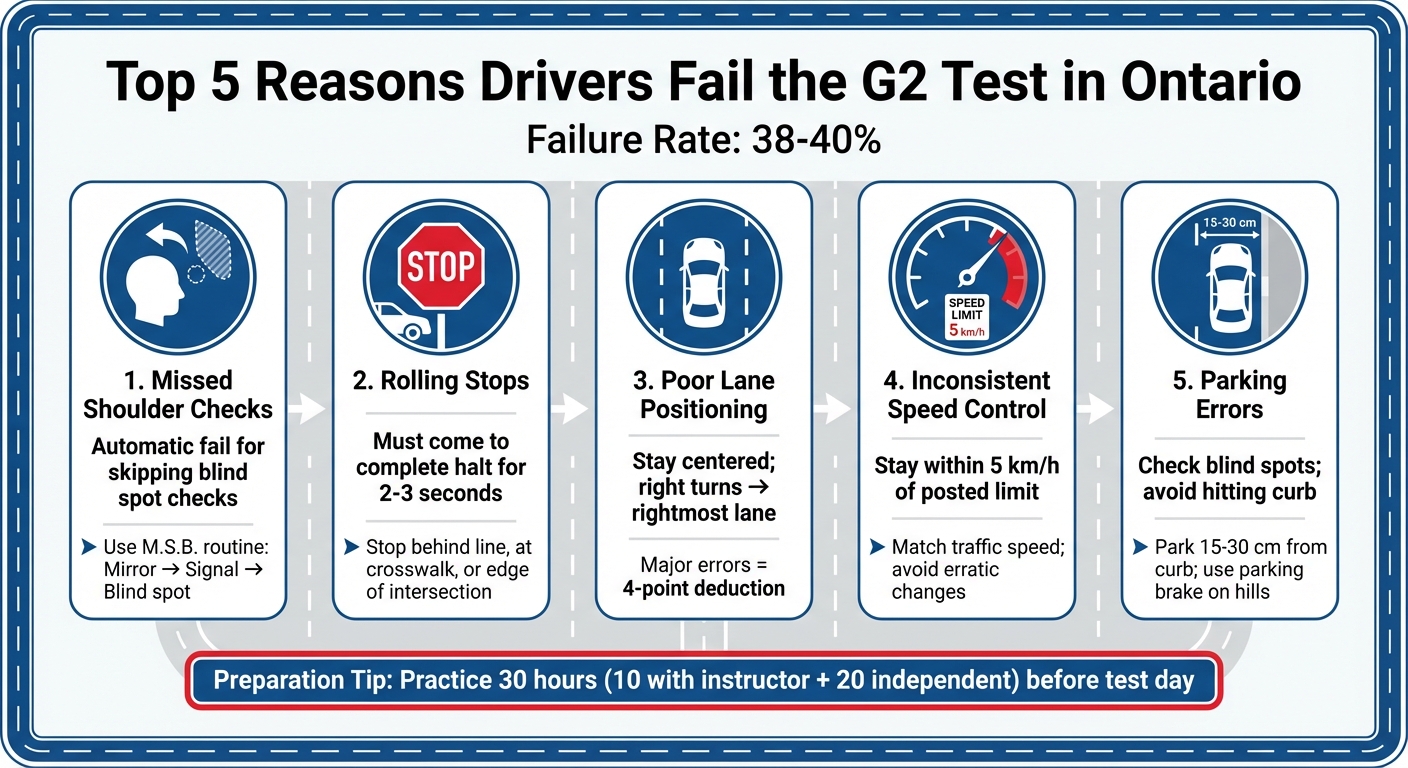
Top 5 Reasons Drivers Fail the G2 Test in Ontario
1. Incomplete Shoulder Checks
Failing to check your blind spot can lead to an automatic fail during your driving test. Blind spots are those areas around your car that mirrors just can't cover - typically near where backseat passengers sit. These spots can hide cyclists, pedestrians, or even entire vehicles.
Examiners pay close attention to whether you perform proper shoulder checks during lane changes, merging, turns, and parking. They want to see a clear, deliberate head turn to confirm you're checking for anything in your blind spot. Simply shifting your eyes without turning your head won't cut it.
"Missing a shoulder check might seem small, but it's one of the most frequent reasons for a drive test fail."
To avoid this mistake, stick to the M.S.B. routine: Mirror, Signal, Blind spot. Start by checking your mirrors, then signal your intentions, and finally, turn your head to check the blind spot before making your move. Make your head turn obvious enough for the examiner to notice - don't just glance with your eyes.
Practising this sequence every time you change lanes or merge will help make it second nature.
"Checking blind spots can be a life-or-death practice while driving."
Now, let’s dive into another common mistake that can trip you up during the test.
sbb-itb-43e39f6
2. Rolling Stops at Stop Signs
A rolling stop happens when you slow down but don’t fully stop your vehicle. Even if your wheels are barely moving, examiners consider this the same as not stopping at all, which leads to an automatic failure of your G2 test.
To execute a proper stop, your car must come to a complete halt. A good way to tell is by feeling the slight "back-settle" when the car’s momentum fully stops. Once you’ve stopped, pause for about 2–3 seconds (count to three) before continuing.
Where you stop is just as important as how you stop. If there’s a white stop line, stop behind it. If there’s no line, stop at the crosswalk - whether it’s marked or unmarked. If there’s no crosswalk, stop at the edge of the sidewalk. And if there’s no sidewalk, stop at the edge of the intersection. Stopping too far forward or in the wrong spot can cost you points, so positioning is key.
After stopping, take the time to scan the intersection thoroughly - look left, centre, right, and then left again. Make sure to turn your head visibly so the examiner sees you checking for hazards, pedestrians, and oncoming traffic. Clear, deliberate observations are a must.
"You must come to a complete stop for all stop signs and red traffic lights." - The Official Ministry of Transportation (MTO) Driver's Handbook
Mastering these stopping habits is essential for passing your test. Practise full stops until it becomes second nature.
3. Poor Lane Discipline and Positioning
Poor lane discipline can quickly derail your G2 test performance. Staying centred in your lane is a must - examiners will watch carefully to see if you're drifting toward the curb or the centre line. Either mistake signals a lack of control over your vehicle. Your car should always sit squarely in the middle of the lane, whether you're driving straight or making a turn.
Turning errors are another common pitfall. When turning right, you must end up in the rightmost lane, and for left turns, you must finish in the leftmost lane. Ending a right turn in the left lane - or vice versa - creates serious collision risks and could result in an automatic fail.
Your positioning before a turn is equally important. For left turns, position your car near the centre line and make sure to fully enter the intersection before turning. Avoid “cutting the corner,” which can put you in the path of oncoming traffic. And while waiting to turn left, always keep your wheels pointed straight. If you're rear-ended while your wheels are turned, your car could be pushed into oncoming traffic - a dangerous scenario.
In addition to maintaining proper lane positioning, your preparatory actions - like checking mirrors, signalling, and performing blind spot checks - must be clear and deliberate. When changing lanes or repositioning, stick to the MSB routine: Mirror, Signal, Blind spot. Examiners pay close attention to these steps. Major lane errors, such as drifting into another lane, can result in a 4-point deduction on your G2 scoring sheet. Repeated drifting or failure to stay in your lane may even lead to an automatic fail.
4. Inappropriate Speed Control
Examiners pay close attention to how well you adjust your speed to match traffic conditions, weather, and road hazards. Striking the right balance is a challenge for many G2 candidates, as both driving too fast and too slow can lead to failure.
Driving 20–30 km/h below the speed limit disrupts traffic flow and forces other drivers to navigate around you. As Licensed Driving Instructor Barış Karatas explains, "Driving significantly under the speed limit can disrupt traffic and show a lack of confidence." If the examiner repeatedly has to prompt you to speed up, it's a strong indicator you've already failed. To avoid this, aim to stay within 5 km/h of the posted limit - for example, between 55–65 km/h in a 60 km/h zone. Consistent speed control is crucial for maintaining safety and ensuring a smooth test experience.
Certain manoeuvres demand even greater attention to speed management. For instance, slowing down too much during a lane change can force vehicles behind you to brake suddenly, which may result in an automatic fail. When merging onto a highway, use the entire acceleration lane to match the speed of traffic - entering the freeway at a significantly lower speed increases the risk of collisions. After making a turn, return to the appropriate speed within 4–5 seconds.
Erratic speed changes are another red flag for examiners. Constantly speeding up and slowing down without a clear reason, such as traffic or weather conditions, shows poor vehicle control. When approaching a curve, reduce your speed before entering the turn. Braking while in the middle of a curve is a technical mistake that examiners are quick to notice. Similarly, when exiting a freeway, wait until you're fully in the exit lane before slowing down - reducing speed while still in active traffic can be dangerous and costly during your test.
5. Parking Errors
Parking is one of those areas where mistakes can quickly add up during your G2 test. Examiners pay close attention to your safety and control when parking, and errors here can cost you critical points - or even lead to an automatic fail. One of the most frequent missteps? Skipping the Mirror, Signal, Blind Spot (MSB) sequence before and during parking. Forgetting to check your blind spots thoroughly can be a dealbreaker.
To avoid this, make sure to physically turn your head and check the rear window when reversing. Don’t be shy - exaggerate your head movements so the examiner knows you’re being thorough.
Another common issue is curb contact. If you lightly graze the curb, you might only lose a couple of points. But hitting it with force or, worse, mounting the curb? That’s usually an automatic fail. Your final position should be 15 to 30 centimetres from the curb. If you’re unsure about your distance, tilt the passenger-side mirror downward for a better view.
Hill parking comes with its own set of rules. Always engage the parking brake and adjust your wheels based on the situation:
- Uphill with a curb: Turn your wheels away from the curb.
- Uphill without a curb or downhill: Turn your wheels toward the edge of the road.
Whatever type of parking you’re doing, remember to keep it slow and steady - walking speed is ideal. Rushing because of pressure from other drivers can lead to sloppy steering or loss of control. Perfecting these techniques not only helps you park safely but also demonstrates solid vehicle control to the examiner.
How to Avoid These Common Mistakes
Steering clear of the mistakes mentioned earlier requires consistent and focused practice. Both the quantity and quality of your practice sessions matter. A good target is 30 hours of in-car practice - split into 10 hours with a certified instructor and 20 hours of independent driving - before your test day.
Getting familiar with the test routes can make a world of difference. Knowing the specific roads, speed limits, and challenging intersections you'll encounter allows you to anticipate your actions instead of reacting on the spot. Websites like Drive Test Routes offer GPS-based routes for DriveTest centres across Ontario. These downloadable maps guide you through the same paths examiners use, giving you the chance to perfect essential habits like shoulder checks and proper signalling. This kind of targeted practice helps make these actions second nature, so nerves won’t trip you up when it counts.
"Familiarity reduces anxiety and helps you anticipate what's coming." - Steerngo
To avoid common errors like missed shoulder checks or rolling stops, your observation habits need to be crystal clear. Since examiners can’t see your eyes - especially if you’re wearing sunglasses - make a point of physically turning your head when checking mirrors and blind spots. This ensures your movements are obvious during every manoeuvre.
It’s also smart to practise at different times of day on your test routes. This lets you experience a variety of traffic conditions and pedestrian activity, helping you prepare for anything. Don’t forget to check all your vehicle’s lights, signals, and horn at least 24 hours before your test to avoid an automatic cancellation.
These preparation steps directly address the common mistakes drivers make. Keep in mind, examiners aren’t looking for perfection - they want to see safe, legal, and confident driving. With the right preparation, you can set yourself up to pass on your first try.
Conclusion
The key issues leading to G2 test failures boil down to five avoidable mistakes: skipping proper shoulder checks, rolling through stops, poor lane discipline, driving at unsuitable speeds, and parking errors.
Passing the G2 test isn't just about basic driving skills - it's about nailing the specific technical details that examiners focus on. Consistent practice helps turn critical safety moves into automatic habits, ensuring you stay calm and capable under test-day pressure. Most failures come from a build-up of small errors, not one big mistake. Examiners aren’t expecting perfection - they’re looking for safe, legal, and confident driving that proves you're ready for the road.
Paying attention to these details can make all the difference. Tools like downloadable GPS-based routes from Drive Test Routes can help you get familiar with the kinds of roads and scenarios you’ll face during the test. By practising with these resources, you can make these skills second nature and greatly improve your chances of passing the G2 test.
FAQs
What counts as a “proper” shoulder check?
A proper shoulder check involves quickly glancing over your shoulder in the direction you plan to move. This should be paired with mirror checks to ensure there are no vehicles, cyclists, or obstacles lurking in your blind spot. This simple yet essential action plays a key role in ensuring safe lane changes and other manoeuvres.
Where exactly should I stop at a stop sign?
When approaching a stop sign, make sure to bring your vehicle to a full and complete stop. Stay stopped for at least 3 seconds to ensure safety. During this time, check carefully for other vehicles and pedestrians. Only proceed when the way is clear and it’s safe to move. Avoid the common mistake of rolling through the stop sign - this could result in failing your driving test.
How can I practise real G2 test routes in advance?
Practising G2 test routes using GPS-guided navigation can help you prepare for the real thing. With Drive Test Routes, you can download GPS-based routes tailored to specific Drive Test Centres across Ontario. These routes mimic the actual test experience, letting you get comfortable with the roads you’re likely to encounter. This kind of preparation can build your confidence and increase your chances of passing the test on your first try.